



UI Strings Scanner lists every string that could reach the user in a React (JSX/TSX) codebase. It parses the AST with ts-morph instead of running the code, so one command covers any React project without a build step or a dev server. Detection relies on JSX semantics, so the scanner is React-only.
Use it to audit hardcoded copy, review tone and wording, catch untranslated strings, or take stock before adopting i18n. The scanner inventories strings and leaves translation-key management to your i18n tooling.
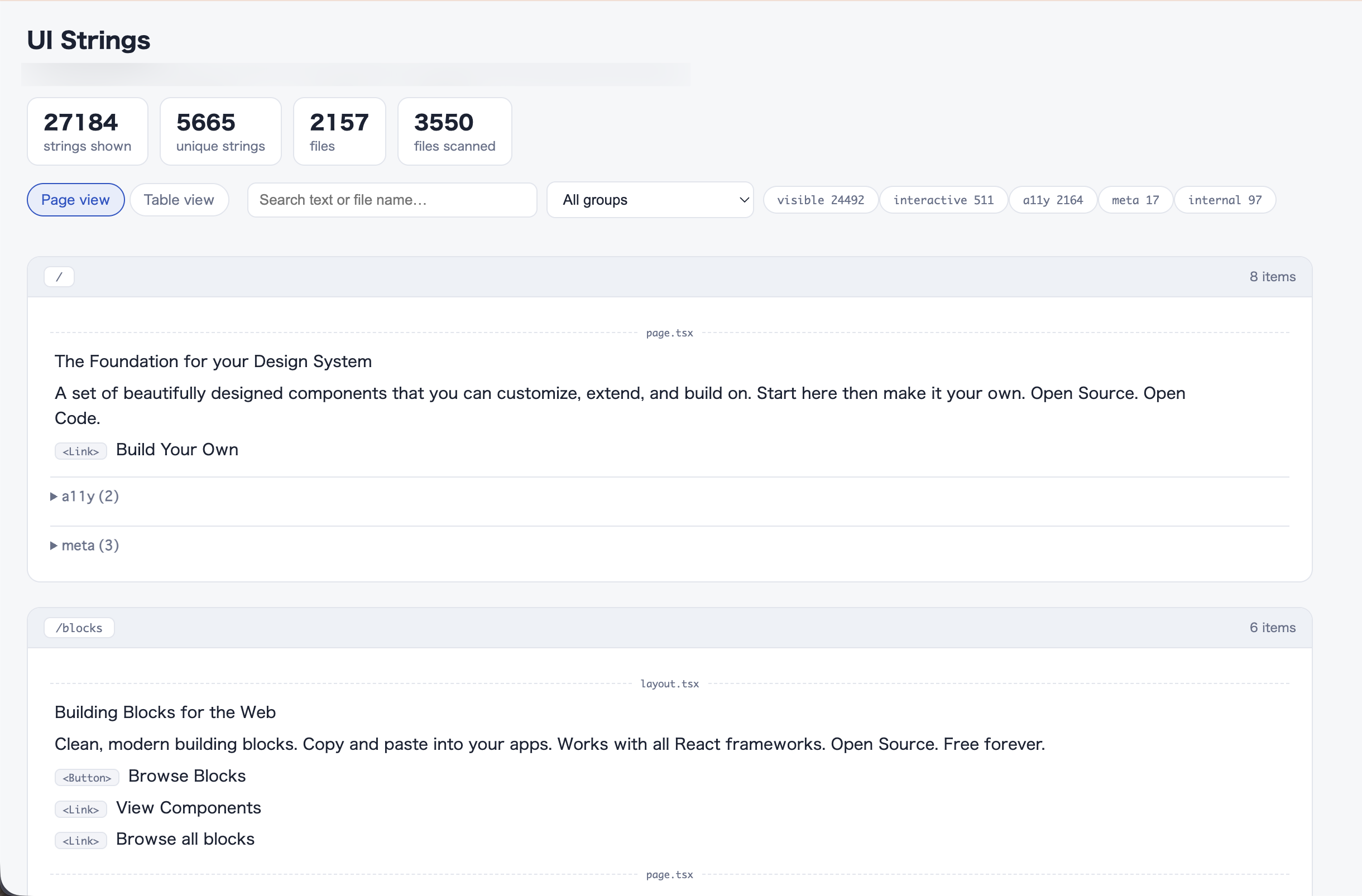
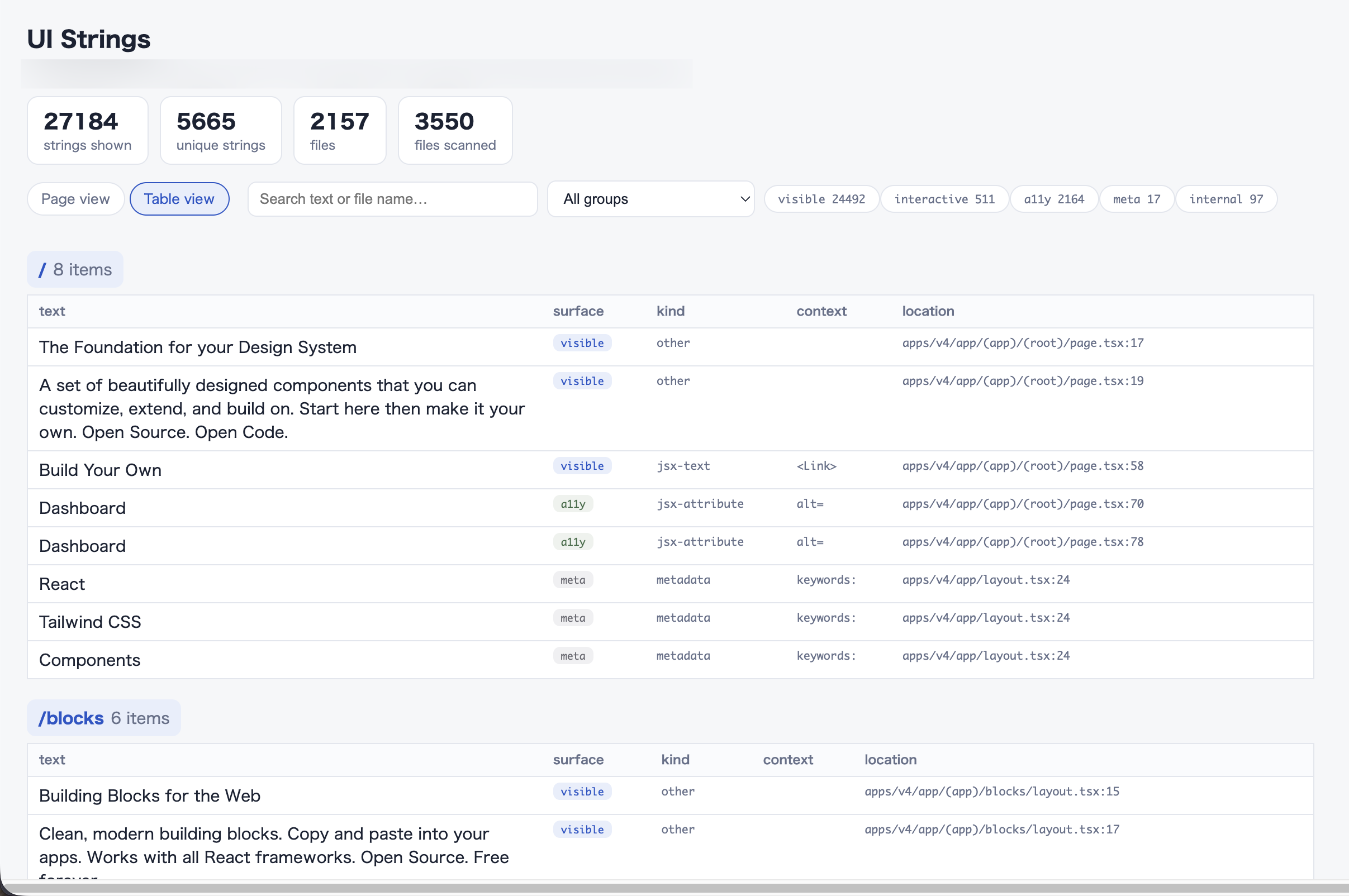
The HTML report for shadcn/ui: 27,000+ strings from 3,550 files, grouped by route and laid out like the page.
Run it at the root of your React project:
npx ui-strings scanScanning: /path/to/my-app/src/**/*.{ts,tsx,js,jsx}
214 strings (+18 internal) / 52 files scanned
visible 163
interactive 31
internal 18
a11y 14
meta 6
→ /path/to/my-app/ui-strings-report/ui-strings.json
→ /path/to/my-app/ui-strings-report/ui-strings.md
→ /path/to/my-app/ui-strings-report/ui-strings.html
The HTML report doubles as a copy-review tool. Spot a string that needs work, click ✎, and type the new copy. The report shows old → new and keeps your edits across reloads.
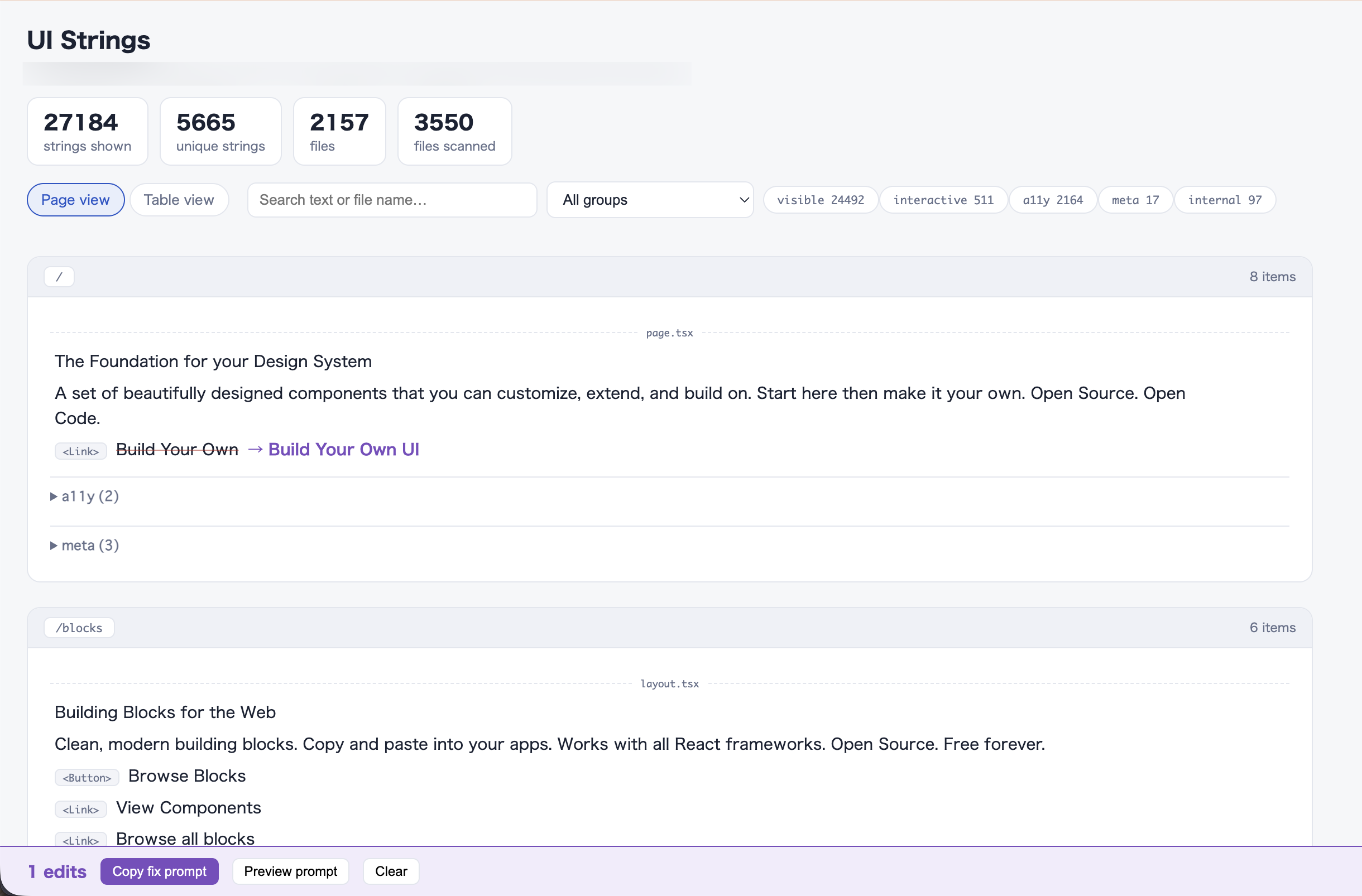
Once your pass is done, Copy fix prompt turns every edit into one prompt with file:line locations. Paste it into Claude Code, Cursor, Codex, or any coding agent, and the agent rewrites the exact literals you marked.
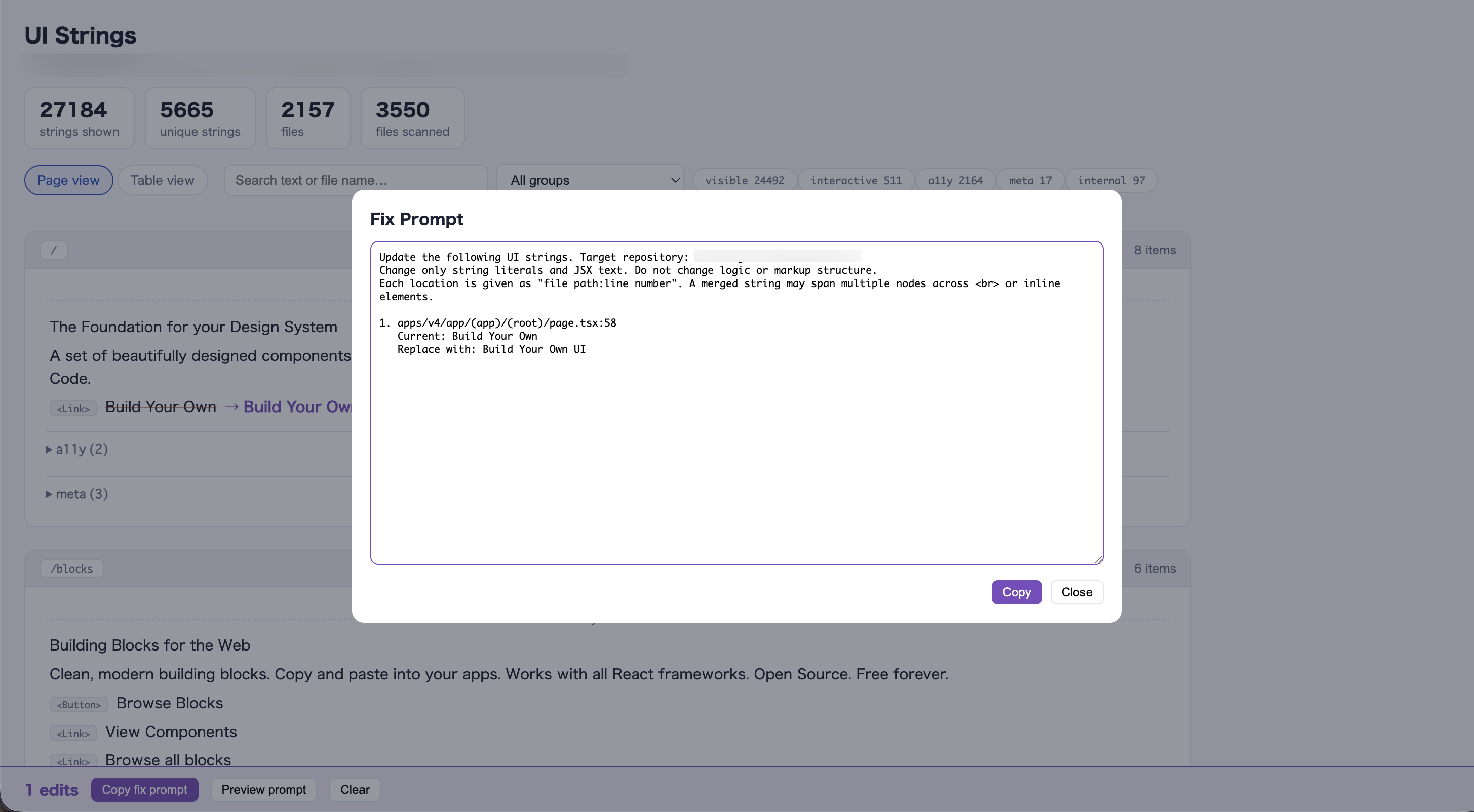
Table view shows one row per string with surface, kind, context, and location columns. Rows copy out as TSV for spreadsheet work.
- Sentence-level extraction -
<p>Hello <b>world</b>,<br />welcome</p>comes out as one string. Embedded expressions become{count}placeholders. - Condition tracking - Strings inside
cond ? A : Borcond && Xcarry their condition, so you know when they show. - Symbol resolution - An option array rendered with
.map()links back to its declaration, across import chains and@/aliases. - Surface classification - Every string carries a tag for how it reaches the user:
visible(rendered as-is),interactive(toasts, validation, API messages),a11y(aria-*,alt,title),meta(Next.js metadata), orinternal(console/throw). - Noise filtering - Class names, import paths, and directives never make the list. Detection combines a string's position (attribute, object key, call argument) with its shape, and treats non-Latin text as copy in any position, so mixed-language projects work.
- Next.js aware - Entries group by App Router route, and
metadatalands undermeta. - Fix prompts - Edit strings in the HTML viewer, then copy all edits as a ready-to-run prompt for an AI coding agent.
npx ui-strings scan [projectDir] [options]projectDir defaults to the current directory.
| Option | Default | Description |
|---|---|---|
--src <glob> |
src/**/*.{ts,tsx,js,jsx} |
files to scan (relative to projectDir) |
--exclude <globs> |
none | extra exclude globs, comma-separated (*.test.* / *.spec.* / __tests__ / __mocks__ are always excluded) |
--out <dir> |
./ui-strings-report |
output directory |
--format <list> |
json,md,html |
output formats |
--include-internal |
off | include console/throw strings in the Markdown listing |
--open |
off | open the HTML report in a browser |
The scanner reads the target project's tsconfig.json when present and resolves path aliases such as @/* through it.
ui-strings.json- every entry withtext,file,line,kind,surface, andconditionui-strings.md- counts by surface, kind, and group, plus the full listingui-strings.html- single-file viewer with search, filters, TSV row copy, and inline editing
Strings built at runtime, such as API responses and computed values, stay invisible to static analysis. The scanner records copy passed across components at its declaration and resolves render sites only for the array .map() pattern. Unknown copy attributes fall back to lexical detection.
The published CLI runs on Node. Development uses Bun.
bun install
bun test
bun run typecheck
bun run build   # bundle dist/cli.js
To try a local build in another React project without publishing:
bun run build
npm link
# In another React project
ui-strings scanIssues and pull requests are welcome.
Junsei Nagao https://github.com/junseinagao