
A Flutter plugin for reading and displaying C2PA (Coalition for Content Provenance and Authenticity) content credentials. It extracts embedded C2PA manifests from media files using the official c2pa-rs Rust library and renders provenance data as interactive Flutter widgets.
- 🗃️ Read C2PA manifests from files or raw bytes.
- 🌳 Display an interactive provenance tree with a detail panel
- 📜 Show manifest details as a popup overlay from any button
- 🔍 Access structured provenance data: actions, ingredients, signatures, EXIF, AI generation info, and more
- ✅ Full validation with trust-list checking
Version 1.0.0 requires Flutter 3.44 or newer, a Rust toolchain, and the
platform build tools for each native target. Dart build hooks compile and
bundle the Rust library through FRB 2.13 Native Assets. The pinned Rust
version and targets are declared in rust/rust-toolchain.toml.
Upgrading from 0.x: update Flutter, run flutter pub get, and rebuild the
host app. Remove any manual Cargokit or c2pa_view podspec integration; the
package no longer registers a native Flutter plugin. RustLib.init() and
the viewer API are unchanged. Web continues to load the separately built
web/pkg WASM package; Native Assets does not replace it.
The build hook tracks Cargo's source inputs and crate configuration, including paths containing spaces. It repairs the upstream dep-info path splitting before publishing the hook output, so source changes rebuild the native reader during ordinary incremental app builds. Missing or unreadable dep-info fails the build instead of leaving an untracked library in the cache.
This package intentionally pins flutter_rust_bridge to a specific tested
version (2.13.0) instead of a broad range.
If you need a different FRB version, update it together with regenerated bindings and verify all target platforms before publishing.
Before any C2PA operations, initialize the Rust library once at app startup:
import 'package:c2pa_view/c2pa_view.dart';

Future<void> main() async {
  WidgetsFlutterBinding.ensureInitialized();
  await RustLib.init();
  runApp(const MyApp());
}A ManifestStore is the root object containing all C2PA manifests found in a file. Create one from any source:
// From a local file path
final store = ManifestStore.fromLocalPath('/path/to/image.jpg');

// From raw bytes and MIME type
final store = ManifestStore.fromBytes(imageBytes, 'image/jpeg');

// From a detached sidecar (.c2pa) plus the bound asset bytes
final store = await ManifestStore.fromDetached(
  manifestBytes: sidecarBytes,
  assetBytes: imageBytes,
  assetFormat: 'image/jpeg',
);

// From a URL (async)
final store = await ManifestStore.fromUrl('https://example.com/image.jpg');
All methods return null if no C2PA manifest is found. For detached reads,
invalid manifest bytes throw; hash/signature problems appear in
validationStatus / validation_results like embedded manifests.
| Entry point | Input | Validation |
|---|---|---|
ManifestStore.fromLocalPath |
File path | Embedded manifest; optional trust anchors |
ManifestStore.fromBytes |
Asset bytes + MIME | Embedded manifest; optional trust anchors |
ManifestStore.fromUrl |
HTTP URL | Embedded manifest; optional trust anchors |
ManifestStore.fromDetached |
Sidecar bytes + asset bytes + MIME | Full hash binding and signatures; optional trust anchors |
getManifestStoreJsonFromBytes |
Manifest-store bytes only | Unverified (no asset binding) |
getDetachedManifestJsonFromBytes |
Sidecar + asset bytes | Validated detached read (JSON) |
Web builds load the regenerated web/pkg/ artifacts (scripts/sync_web_pkg.sh
after Rust changes). Detached validation uses the same FRB/WASM exports as
native.
VM integration: flutter test test/detached_manifest_test.dart (requires the
monorepo signing corpus; uses dart:io — not a Chrome target).
Web smoke (manual, testfiles_app):
- From
frontend/c2pa_view, runscripts/sync_web_pkg.sh. cd testfiles_app && flutter run -d chrome.- Confirm the home screen loads without a Rust init timeout banner.
- Tap Validate detached sidecar on the Detached sidecar check card.
- Expect
validation_state: Validand(assertion.dataHash.match present). Without trust-list initialization,signingCredential.untrustedin the JSON is normal — the smoke check only requires hash binding success.
Every native and WASM read entry point enriches only manifest and ingredient
thumbnail objects using SDK resource stores belonging to the containing claim.
SDK resource_len preflights borrowed assertion/databox lengths before any lazy
copy; unknown or flattened-manifest-only references fail closed. A bounded output
writer also protects the subsequent copy.
The object retains format/identifier and adds resolution,
containing_manifest, and a byte-array data only when resolved. Outcomes are
resolved, missing, malformed, unsupported, oversize, or limit;
an absent thumbnail remains absent (including deliberate producer omission).
HTTP/file/data resource identifiers are never fetched. JPEG and PNG previews,
including JPEG video posters, use the same portable contract.
Hydration visits at most 256 manifests and 1024 ingredient/thumbnail references.
Identifiers are limited to 4096 bytes, copied containing-claim labels to 256 bytes,
and MIME strings to 128 bytes. Each image is limited to 1 MiB encoded; all new
preview bytes and annotations together use at most 8 MiB serialized JSON,
including escaped context strings, failure outcomes, keys and repeated copies.
Each image is limited to 4096 pixels on either edge and 4 MiB decoded RGBA;
all emitted references together may require at most 16 MiB decoded RGBA.
Standard JPEG/PNG decoders validate pixels before emission, preserve original
encoded bytes and reject animated PNG. Codec max_alloc assists these checks;
it is not a hard heap ceiling. Repeated references
share bounded lookup outcomes but each returned byte copy counts toward the
aggregate limits. Work is iterative, visits each manifest once and does not follow
ingredient cycles. When traversal or annotation stops, the store emits
preview_resources_truncated: true; unvisited references retain their original
metadata and the Dart entities expose limit, without copying more labels/data. These bounds cover additional preview hydration, not SDK
parsing of the caller-supplied original store. Unsupported, malformed and oversized images are omitted before Flutter decode;
resolution alone proves no validity,
issuer trust or access authorization.
Graph previews prefer a node's own claim bytes, then an ingredient preview from
its consuming claim. The latter retains that containing claim's label and
validation result separately from the ancestor's signature/validation.
Per-claim validation_status comes from the current SDK validation log before
delta de-duplication; historical ingredient reports never override current trust.
A present empty list is a current clean result; an absent sideband is not
computed, represented by null PreviewSource.validationResult. Node summaries,
details, and latest-Seal presentation show a neutral Not verified state when
current diagnostics are absent. That state still has a credential and is distinct
from No CR for an unresolved leaf without one. Computed clean [] remains
valid; nonempty invalid/untrusted evidence retains precedence. The shared
mapValidation bare-list API continues to treat explicitly supplied lists as
computed for compatibility; manifest-aware callers pass validationStatusComputed.
The compact indicator uses the same neutral theme color and an unknown icon. A computed list
must be complete and well-formed: malformed/partial diagnostics never become a
clean result after filtering. Store attribution retains raw malformed rows so the
containing claim stays unverified (unattributable rows fall back to the active
claim), while valid failure/untrusted evidence still takes precedence. Null
optional URL/explanation fields and extensible status codes/extra fields retain
their existing semantics. Attribution and loading consume the same normalized manifest
collection; non-map target values are skipped once and existing strict parse
failures still reject the store. Missing or unloaded targets retain negative and
incomplete evidence through active fallback. Unmatched claim-specific successes
remain global evidence and cannot establish active validity; genuine active clean
results, matched-claim successes and existing unscoped active successes remain
supported. Recorded non-trust
input failures (for example dataHash mismatch) remain separate incoming evidence,
with their containing claim and its current validation. They still make the
corresponding input presentation invalid, even when its current signature is
trusted; neither preview resolution nor a clean latest Seal erases that evidence. Unresolved
leaves retain no-credential labels. Real components and two-hop ancestry remain
visible. Authorized host thumbnails still take precedence and mediaImage remains
a root-only fallback; embedded lookup never requests an original or remote URL.
Resource regression: flutter test --no-pub test/embedded_preview_test.dart.
The synthetic pixel fixture must decode/render and preserve source/trust context,
not merely contain a resource key. Native readback lives in the Rust API tests.
Native/WASM signed readback: flutter test --no-pub --concurrency=1 test/embedded_resource_readback_test.dart. This uses the same synthetic signed
2x2 PNG on both targets, checking claim bytes, JPEG ingredient posters, two hops,
multiple components, source validation and decoded red/blue pixels.
Browser resource-resolution smoke (local synthetic input only):
- Build
CARGO_BUILD_JOBS=1 bash scripts/sync_web_pkg.sh --no-demo-copies. - Serve
web/locally with CORS allowed for the Flutter test runner origin (for example onhttp://127.0.0.1:8765; no credentials or hosted content). - Run
flutter test --no-pub --platform chrome --concurrency=1 --dart-define=VERIFIER_ASSET_BASE=http://127.0.0.1:8765/pkg/ test/embedded_resource_readback_test.dart test/embedded_preview_test.dart. - Expect both signed resource readback and rendered pixel tests to pass. The native and browser test use identical fixture bytes and pixel/outcome assertions. The test runner must have a working local Chrome executable.
To regenerate the signed synthetic fixture, run the Rust
embedded_previews_use_containing_stores_and_all_reader_paths test with
T2057_FIXTURE_DIR=/tmp/preview-fixtures; base64-encode its
embedded-preview.png into test/fixtures/embedded_preview_fixture.dart.
Only public SDK test certificates are embedded, never signing keys.
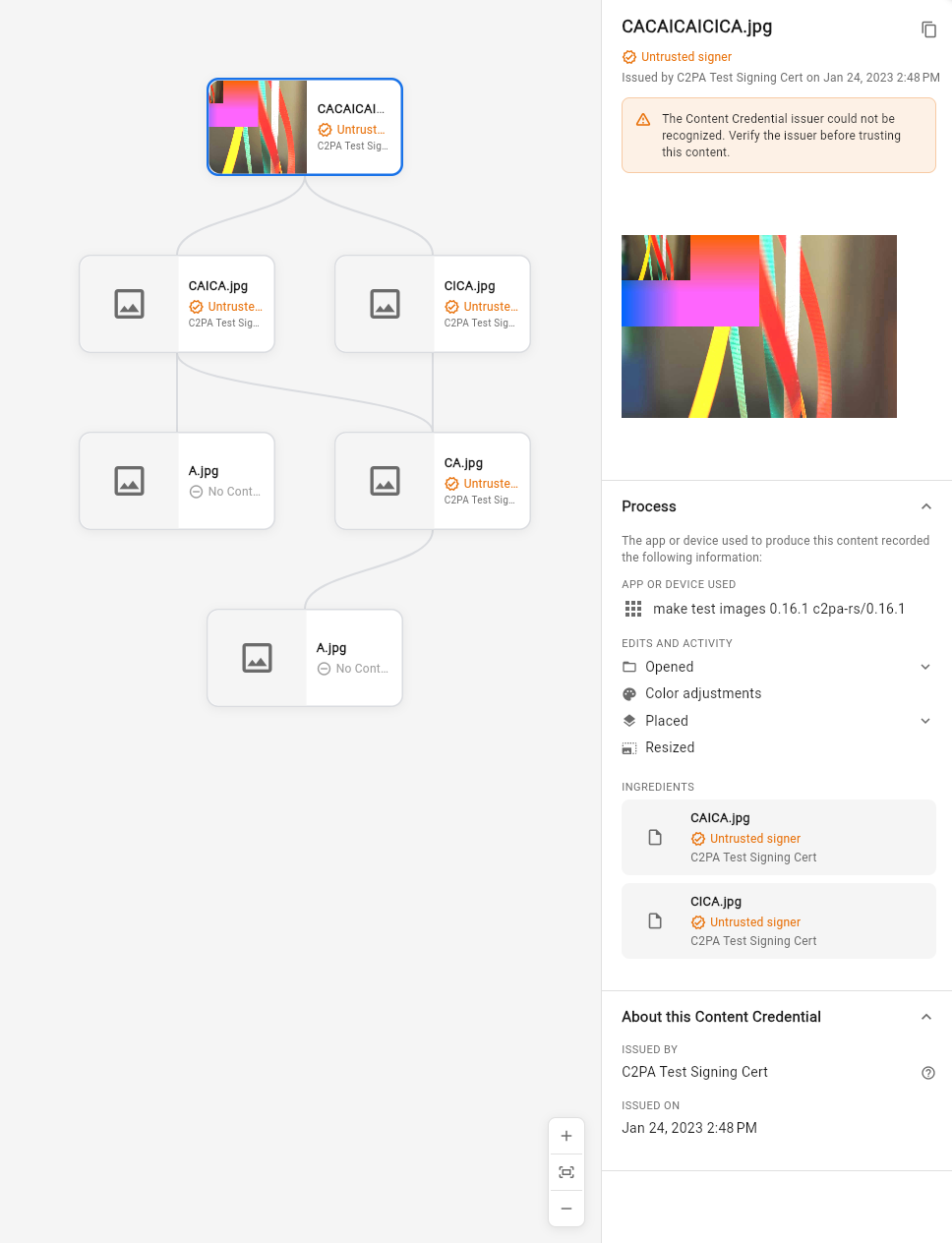
C2paManifestViewer shows an interactive provenance tree on the left and a detail panel on the right. Clicking a tree node updates the detail panel.
import 'package:c2pa_view/c2pa_view.dart';

// 1. Load the manifest store
final store = ManifestStore.fromBytes(imageBytes, 'image/jpeg');
if (store == null) return const Text('No manifest found');

// 2. Build the provenance graph (DAG of all manifests)
final graph = ProvenanceMapper.mapToGraph(store);

// 3. Display the full viewer wrapped in a theme
C2paViewerTheme(
  data: const C2paViewerThemeData(),
  child: C2paManifestViewer(
    graph: graph,
    mimeType: 'image/jpeg',
    mediaImage: MemoryImage(imageBytes), // fallback when no embedded thumbnail
  ),
);
See testfiles_app/lib/main.dart — the ManifestViewerPage class demonstrates this pattern with network-loaded images.
showManifestDetailPopup opens a positioned overlay anchored to any widget. This is useful for adding a "content credentials" button to image thumbnails.
import 'package:c2pa_view/c2pa_view.dart';

// 1. Load the manifest store
final store = ManifestStore.fromBytes(imageBytes, 'image/jpeg');
if (store == null) return;

// 2. Get the active manifest and map it to a view model
final manifest = store.manifests[store.activeManifest]!;
final viewData = ManifestViewDataMapper.map(manifest);

// 3. Use a Builder to get a BuildContext anchored to the button
Builder(
  builder: (buttonContext) {
    return IconButton(
      icon: const Icon(Icons.verified_user),
      onPressed: () {
        showManifestDetailPopup(
          buttonContext,
          data: viewData,
          mimeType: 'image/jpeg',
          mediaImage: MemoryImage(imageBytes),
        );
      },
    );
  },
);
See testfiles_app/lib/main.dart — the _PopupDemoCard class demonstrates this pattern with a thumbnail and icon button.
Wrap your widget tree with C2paViewerTheme to customize the appearance. All c2pa_view widgets read from this theme, falling back to defaults when absent.
C2paViewerTheme(
  data: const C2paViewerThemeData(
    validColor: Color(0xFF1B8D3E),
    invalidColor: Color(0xFFD93025),
    sidebarWidth: 400,
  ),
  child: C2paManifestViewer(graph: graph),
);

// Dark mode
C2paViewerTheme(
  data: C2paViewerThemeData.dark(),
  child: C2paManifestViewer(graph: graph),
);
C2paViewerThemeData controls: validation status colors, surface/border/text colors, six text style tiers, layout dimensions (sidebar width, thumbnail size, node spacing), and border radii.
You can use the package purely for data extraction without any widgets:
final store = ManifestStore.fromLocalPath('/path/to/image.jpg');
if (store == null) return;

final manifest = store.manifests[store.activeManifest]!;

// Access structured data
print(manifest.title);
print(manifest.signatureInfo?.issuer);
print(manifest.ingredients.length);
print(manifest.actions?.map((a) => a.action));

// Or get the raw JSON string
final json = C2paBridgeService.getManifestJsonFromFile('/path/to/image.jpg');This is an FFI plugin with native Rust code built through Dart hooks:
| Platform | Status |
|---|---|
| Android | Supported |
| iOS | Supported (Native Assets verified on iPhone) |
| Linux | Supported |
| macOS | Supported |
| Windows | Supported |
Web release hosts can set VERIFIER_ASSET_BASE to an immutable package prefix;
initRustLib() passes it to FRB's exposed web-module loader. The
compatibility default remains pkg/, with native loading unchanged. Concurrent
calls share one initialization future. Browser hot restart reuses only a
successfully initialized bridge from that exact prefix; failed or timed-out
initialization requires a full page reload so partial globals cannot be reused.
The shared Dart projection preserves nonempty Ingredient.description strings
verbatim, with consuming-claim label and ingredient-array position. This is
recorded payload prose, not a new viewer check or trust verdict. Reachable
ancestry, distinct incoming edges, unresolved leaves and collapsed Seals retain
that context; unrelated loaded consumers do not contribute prose. Optional
presentation fields default to empty for compatible existing constructors.
Generic lists/details use plain wrapped text and fixed graph cards expose full
text on hover; InReality popovers use the existing highlight-row transport,
including hosts that already have other highlights. Host thumbnails preserve the
projection. Invalid/untrusted precedence, Not verified versus No CR, previews,
authenticated fetches and interaction/export callbacks retain their existing
meaning. No description causes original-media or remote-resource fetching.