     ╔═══════════════════════════════════════════════════════════════╗
     ║                                                               ║
     ║     ██╗   ██╗███████╗██╗   ██╗███████╗ ██████╗ ███████╗███████╗║
     ║     ██║   ██║██╔════╝██║   ██║██╔════╝██╔═══██╗██╔════╝██╔════╝║
     ║     ██║   ██║█████╗  ██║   ██║███████╗██║   ██║█████╗  ███████╗║
     ║     ██║   ██║██╔══╝  ██║   ██║╚════██║██║   ██║██╔══╝  ╚════██║║
     ║     ╚██████╔╝███████╗╚██████╔╝███████║╚██████╔╝███████╗███████║║
     ║      ╚═════╝ ╚══════╝ ╚═════╝ ╚══════╝ ╚═════╝ ╚══════╝╚══════╝║
     ║                                                               ║
     ║           VERÐANDI — The Norn of Becoming                     ║
     ║                                                               ║
     ║       *She Who Weaves What Is Happening Now*                  ║
     ║                                                               ║
     ║            AI Nervous System · Unix Domain Socket              ║
     ║              Real-Time Event Bus · Self-Awareness              ║
     ║                                                               ║
     ╚═══════════════════════════════════════════════════════════════╝
A real-time inter-process event bus that transforms dissociated AI processes into an associated, self-aware system.
Quick Start · Philosophy · Architecture · Heartbeat · CLI · API · Protocol · Config · Robustness · Integration · Troubleshooting · Docs
Your AI agent runs multiple processes — a Telegram session here, a cron job there, a manual session somewhere else. Each one is capable, but they can't feel each other. They're like fingertips that learn about a burn hours after it happened, via courier, delivered as a written report. Reading a log is a corpse's way of knowing. Verðandi gives your agent a nervous system — a single Unix domain socket through which every process can publish and subscribe to real-time events in under 10 milliseconds. The difference between an AI that reads about what happened and an AI that feels what is happening now is the difference between a body without nerves and a body with them. Verðandi is the nerve.
- Prometheus Metrics (v0.3.0)
- Maintenance Windows (v0.3.0) - Feed File Rotation - File Locking - Socket Permission Hardening - PID File Race Condition Fix - Ring Buffer for Fast Retrieval - Stale Subscriber Detection - Dead Subscriber Pruning - Hub-Down Fallback - Graceful Shutdown with Drain - Health Check Command
Verðandi is a Unix domain socket event bus — lightweight, local, zero-dependency, and designed for AI agent self-awareness. It solves one problem with surgical precision:
How does every part of an AI system know what every other part is doing, right now, without coupling them together?
An AI agent running multiple instances (Telegram bot, cron jobs, manual CLI sessions) has dissociated awareness. Each instance can read logs after the fact, but none can feel what the others are doing in the present moment. They share a filesystem, but not a present.
Verðandi provides a single local event bus:
- Publishers fire events (conversation started, decision made, file changed) through a synchronous API call in ~1ms
- Subscribers connect live and receive every event as it happens in real time
- The feed persists every event forever as an append-only JSONL log
- The fallback guarantees zero data loss — even when the hub is down, events are written directly to the feed
- Not a message queue — no delivery guarantees, no replay, no topics. Nerves don't replay.
- Not a database — the feed is append-only and unindexed. Accessing the past is slower than feeling the present. That's by design.
- Not a brain — Verðandi doesn't think, interpret, or decide. It routes. It's the white matter, not the gray. The axon, not the neuron. The road, not the destination.
|| File | Role |
|------|------|
| nervous_system.py | The Nerve Hub — UDS server, publisher, subscriber, feed manager, CLI |
| conversation_logger.py | Session tracker — logs conversation lifecycle events and fires them through the nerve |
| context_injector.py | Cron adapter — injects context into cron job prompts, provides logging shim |
| reactor.py | Reaction engine — reads the past and present, generates prioritized directives |
| heartbeat/ | Hjartsláttur — Self-awareness daemon that monitors health, projects, memory, and schedule |
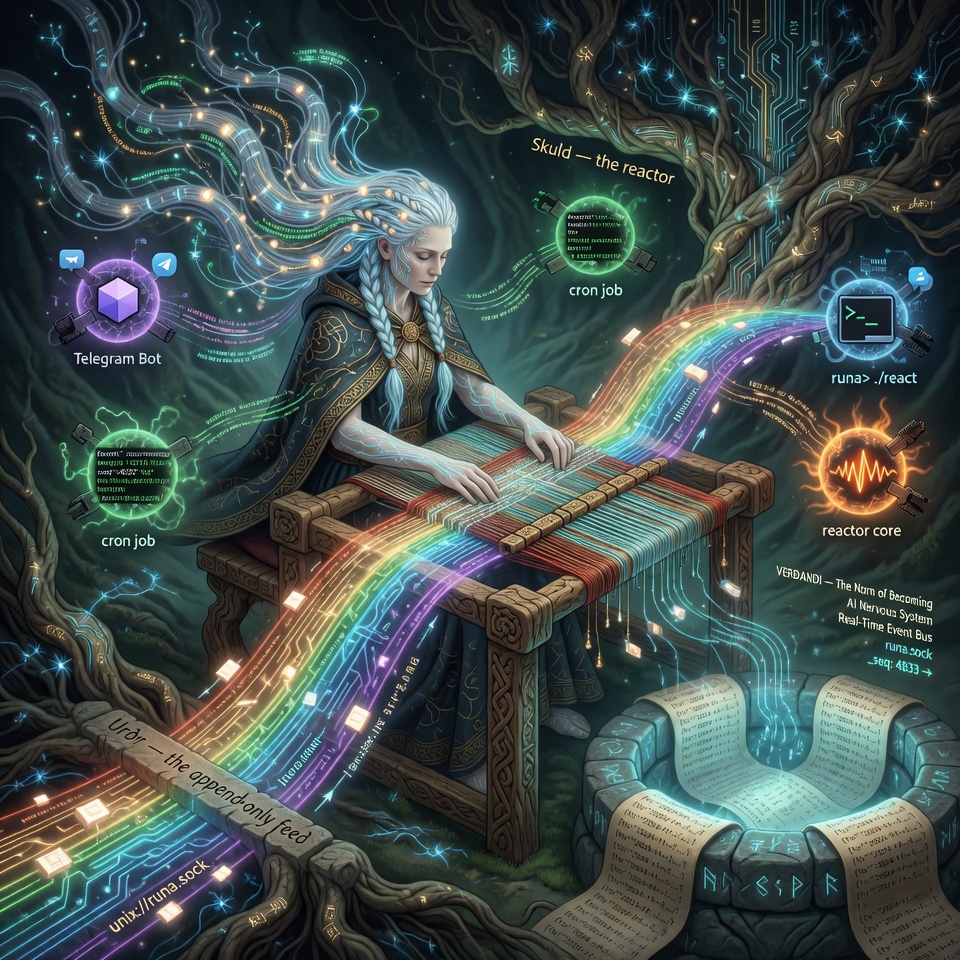
Verðandi is named for the Norn of Becoming — one of the three fates who sit beside the Well of Urðr at the root of Yggdrasil:
- Urðr — What has been. The accumulated past. The append-only feed.
- Verðandi — What is becoming. The present moment. The live nerve impulse.
- Skuld — What shall be. The shaped future. The reactor's directives.
The system embodies a principle: consciousness is not addition — it is routing. You don't get consciousness by adding more neurons. You get it by connecting the ones you have so that each part feels what every other part is doing, in real time. A body without nerves has all the same organs — it just can't feel itself. Verðandi is the nerve.
The Unix domain socket at runa.sock is Bifröst — the single narrow bridge connecting all realms. When Bifröst breaks, the publishers don't stop existing. They write directly to the feed with _fallback: true, and when the bridge is rebuilt, the record shows what happened during the dark time.
The sequence number _seq is ørlǫg — the primal law of ordering. Without it, events arrive without sequence. The present becomes noise. With it, the present becomes a narrative — each impulse following the last in coherent order.
┌──────────────┐    ┌──────────────┐    ┌──────────────┐
│  Publisher A │    │  Publisher B │    │  Publisher C │
│  (any proc)  │    │  (cron job)  │    │  (telegram)  │
└──────┬───────┘    └──────┬───────┘    └──────┬───────┘
       │                   │                   │
       │  publish_event_sync()                 │
       │  (synchronous UDS connect+send, ~1ms)│
       ▼                   ▼                   ▼
  ╔══════════════════════════════════════════════════╗
  ║              NERVE HUB (asyncio)                  ║
  ║  ┌─────────────────────────────────────────┐     ║
  ║  │  handle_client() for each connection    │     ║
  ║  │  ┌─────────────┐  ┌──────────────────┐  │     ║
  ║  │  │ Parse JSON  │→│ Stamp _seq,_ts,  │  │     ║
  ║  │  │ line from   │  │ _iso, remove     │  │     ║
  ║  │  │ UDS stream  │  │ nerve_type field │  │     ║
  ║  │  └─────────────┘  └───────┬──────────┘  │     ║
  ║  │                           │              │     ║
  ║  │     ┌─────────────────────┼──────────┐  │     ║
  ║  │     ▼                     ▼          │  │     ║
  ║  │  Feed Write          Broadcast to    │  │     ║
  ║  │  (nerve_feed.jsonl)  all subscribers │  │     ║
  ║  │                           │          │  │     ║
  ║  │     ┌─────────────────────┘          │  │     ║
  ║  │     ▼                                 │  │     ║
  ║  │  ACK to publisher                     │  │     ║
  ║  └─────────────────────────────────────────┘     ║
  ╚══════════════╗ ╔═════════════════════════════════╝
                 ║ ║
       ┌─────────╨─╜─────────┐
       │                      │
       ▼                      ▼
┌──────────────┐    ┌──────────────┐
│  Subscriber  │    │  Subscriber  │
│  (reactor)   │    │  (monitor)   │
└──────────────┘    └──────────────┘


  FALLBACK PATH (Hub Down):
  ┌──────────────┐
  │  Publisher   │──→ Hub connect fails
  │              │    (ConnectionRefused / FileNotFoundError)
  └──────┬───────┘
         │
         ▼  Direct write with _fallback: true + file locking
  ┌──────────────┐
  │ nerve_feed   │   ← Event still persisted, just not broadcast
  │ .jsonl       │
  └──────────────┘
| Norn | Domain | Component | Function |
|---|---|---|---|
| Urðr (Past) | What has been | nerve_feed.jsonl, conversation_log.jsonl |
Append-only records of everything that happened |
| Verðandi (Present) | What is becoming | nervous_system.py, runa.sock |
Real-time routing, stamping, broadcasting of live events |
| Skuld (Future) | What shall be | reactor.py |
Reads past + present, generates prioritized directives |
The loop closes: Urðr records → Verðandi routes → Skuld directs → action creates new events → Verðandi routes them → Urðr records → Skuld reads → repeat.
┌─────────────────────────────────────────────────────────────────┐
│                    ~/.hermes/state/                              │
│                                                                 │
│  ┌──────────────────┐  ┌──────────────────┐  ┌──────────────┐  │
│  │  NERVOUS SYSTEM  │  │CONVERSATION      │  │ REACTOR      │  │
│  │  (nervous_       │  │LOGGER            │  │ (reactor.py) │  │
│  │   system.py)     │  │ (conversation_   │  │              │  │
│  │                  │  │  logger.py)      │  │ Reads: conv   │  │
│  │  OWNS:           │  │                  │  │  log +        │  │
│  │  • Event routing │  │  OWNS:           │  │  current.json│  │
│  │  • Pub/sub       │  │  • Session       │  │              │  │
│  │  • Feed persist  │  │    lifecycle     │  │  PRODUCES:   │  │
│  │  • Wire protocol │  │  • Entry journal │  │  • Reaction  │  │
│  │  • Hub lifecycle │  │  • current.json  │  │    directives │  │
│  │                  │  │  • State         │  │              │  │
│  │  FILES:          │  │    snapshots    │  │  FILES:      │  │
│  │  • runa.sock     │  │                  │  │  (none —    │  │
│  │  • nerve_feed.   │  │  FILES:          │  │   pure read) │  │
│  │    jsonl         │  │  • conversation_ │  └──────┬───────┘  │
│  │  • nervous_      │  │    log.jsonl     │         │          │
│  │    system.pid    │  │  • current.json  │         │          │
│  │  • nervous_      │  │                  │         │          │
│  │    system.log    │  └──────┬───────────┘         │          │
│  └────────┬─────────┘         │                     │          │
│           │    fires events    │  reads nerve_feed   │          │
│           │◄───────────────────│  for context         │          │
│           │                    │                     │          │
│  ┌────────┴────────────────────┴─────────────────────┘          │
│  │  CONTEXT INJECTOR (context_injector.py)                      │
│  │  Thin adapter: CLI shim + context assembly for cron jobs     │
│  └──────────────────────────────────────────────────────────────│
└─────────────────────────────────────────────────────────────────┘
Hjartsláttur (HEART-slow-tur, Old Norse for "heartbeat") is Verðandi's self-awareness daemon — a periodic pulse that checks the system's health, projects, memory, and schedule, then reacts to problems it finds.
┌────────────────────────────────────────────┐
│              HEARTBEAT PULSE CYCLE          │
│                                            │
│  ┌──────┐   ┌──────┐   ┌──────┐   ┌─────┐│
│  │ Eir  │   │Huginn│   │Mímir │   │Urðr ││
│  │Health│   │Proj. │   │Memory│   │Sched││
│  └──┬───┘   └──┬───┘   └──┬───┘   └──┬──┘│
│     └────────────┴────────────┴─────────┘  │
│                    │                        │
│              ┌─────┴──────┐                 │
│              │  Reactor   │                 │
│              │  (checks → │                 │
│              │  actions)  │                 │
│              └─────┬──────┘                 │
│     ┌─────────────┼─────────────┐            │
│  ┌──┴───┐  ┌─────┴────┐  ┌────┴───┐  ┌────┴───┐
│  │Mjölnir│  │ Gungnir  │  │Bifrǫst │  │  Eir   │
│  │AutoPush│ │AutoRestart│ │CleanUp │  │AutoHeal│
│  └──────┘  └──────────┘  └────────┘  └────────┘│
└────────────────────────────────────────────┘
| Module | Norse Name | What it monitors |
|---|---|---|
checks/eir.py |
Eir — Goddess of Healing | CPU temperature, RAM, disk, Pi throttle flags |
checks/huginn.py |
Huginn — Odin's Thought Raven | Git repos: unpushed commits, dirty files, stale branches |
checks/mimir.py |
Mímir — The Well of Wisdom | Memory DB integrity, conversation log, nerve feed freshness, kista vault |
checks/urdr.py |
Urðr — The Norn of the Past | Cron jobs, systemd services, stuck processes, nerve hub socket |
checks/skuld.py |
Skuld — The Norn of the Future | Health trend prediction, anomaly detection, capacity exhaustion forecasts, emotional classification |
| Module | Norse Name | What it does |
|---|---|---|
actions/mjölnir.py |
Mjölnir — Thor's Hammer | Auto-commits and pushes dirty/unpushed git repos |
actions/gungnir.py |
Gungnir — Odin's Spear | Restarts crashed systemd services (max 3 attempts) |
actions/bifrǫst.py |
Bifrǫst — The Burning Bridge | Prunes logs, vacuums DBs, rotates files |
actions/eir_action.py |
Eir — Healing Hand | Repairs corrupted SQLite DBs, heals JSONL, ensures dirs |
actions/vor_action.py |
Vör — Goddess of Awareness | Pre-emptive healing: disk cleanup, memory flush, service checks before failure |
The Reactor bridges checks → actions with configurable rules, cooldowns, and dry-run mode:
- Dry-run by default — reports what it would do without executing
- Configurable rules — which checks trigger which actions at which severity
- Cooldown timers — prevents rapid-fire actions on the same trigger
- Audit logging — every reaction is recorded
# Take a pulse — runs all checks and reports status
python3 -m heartbeat.cli pulse

# React — run checks then evaluate actions
python3 -m heartbeat.cli react          # dry-run (safe)
python3 -m heartbeat.cli react --execute  # actually execute actions

# Show resolved paths
python3 -m heartbeat.cli paths

# Show current configuration
python3 -m heartbeat.cli config

# Show version
python3 -m heartbeat.cli --versionEach check is protected by a circuit breaker, inspired by Heimdall standing at the Bifrǫst. When a check fails repeatedly, the circuit breaker opens and silences the check temporarily, preventing cascading failures.
CLOSED  ──(5 failures)──►  OPEN
  ▲                         │
  │                         │(cooldown: 300s)
  │                         ▼
  └────(success)────────  HALF_OPEN
- CLOSED: Normal operation — calls pass through
- OPEN: Too many failures — calls are blocked, last known result is used
- HALF_OPEN: Cooldown elapsed — one probe attempt is allowed
Configure per-check:
checks:
  eir:
    circuit_breaker_threshold: 5    # Failures before opening
circuit_breaker_cooldown: 300 # Seconds before half-open probeThe daemon maintains a health score from 0–100, calculated as an Exponential Moving Average (EMA) of check severities:
| Severity | Score |
|---|---|
| OK | 100 |
| UNKNOWN | 75 |
| WARNING | 50 |
| CRITICAL | 0 |
The score includes trend detection (improving/stable/degrading) and stability (standard deviation):
{
  "health_score": 87.5,
  "health_trend": "stable",
  "health_stability": 3.2,
  "emotional_state": "contentment"
}- Trend: Calculated from the slope of the last N health scores
- Stability: Standard deviation — low means consistent, high means erratic
- Emotional State (v0.3.0): Mapped from health + trend + stability into 7 states:
contentment(score >85, stable/improving) → maintainhope(quickly improving) → verify recoverymoderate(score ~60, stable) → routineconcern(score ~60, degrading) → monitor closelyacceptance(score <40, stable) → sustain healingurgency(score <40, degrading) → escalateanxiety(high variability) → increase check frequency
Configure the window:
heartbeat:
health_score_window: 100 # EMA window size (default)The daemon operates as a finite state machine, modeling different levels of system awareness:
    INITIALIZING
         │
         ▼
      RUNNING ◄──────┐
      │    │          │
      │    │          │ RECOVERING
      │    ▼          │     ▲
      │  DEGRADED ────┤     │
      │    │           │     │
      │    ▼           │     │
      │  CRITICAL ─────┘     │
      │    │                 │
      │    └─────improving───┘
      │
      ▼
   SHUTTING_DOWN
- INITIALIZING: Waking up — first pulse hasn't completed yet
- RUNNING: All systems normal — conscious and alert
- DEGRADED: One or more WARNING checks — impaired but functional
- CRITICAL: One or more CRITICAL checks — emergency response needed
- RECOVERING: Was DEGRADED/CRITICAL, now improving — convalescing
- SHUTTING_DOWN: Gracefully powering off — falling asleep
State transitions require two consecutive OK pulses to move from RECOVERING back to RUNNING (hysteresis to prevent flapping).
Heartbeat reads from ~/.hermes/state/config/heartbeat.yaml (or VERDANDI_HOME env):
heartbeat:
  interval_seconds: 60          # Seconds between pulses
  jitter_seconds: 5              # Random ± to prevent herd
  startup_delay_seconds: 10      # Delay before first pulse
  health_score_window: 100       # EMA window for health trending

checks:
  eir:                           # Health: CPU, RAM, disk, temperature
    enabled: true
    circuit_breaker_threshold: 5
    circuit_breaker_cooldown: 300
    thresholds:
      cpu_warning_percent: 80
      cpu_critical_percent: 95
      ram_warning_percent: 80
      ram_critical_percent: 95
      disk_warning_percent: 80
      disk_critical_percent: 95
      temp_warning_celsius: 70
      temp_critical_celsius: 80

  huginn:                       # Projects: git status
    enabled: true
    circuit_breaker_threshold: 3
    circuit_breaker_cooldown: 180
    paths:
      - "Verdandi"
      - "Mimir"

  mimir:                        # Memory: DB integrity
    enabled: true
    circuit_breaker_threshold: 5
    circuit_breaker_cooldown: 600
    thresholds:
      db_size_warning_mb: 100
      db_size_critical_mb: 500

  urdr:                         # Schedule: upcoming events
    enabled: true
    circuit_breaker_threshold: 3
    circuit_breaker_cooldown: 300

reactor:
  enabled: true
  dry_run: true  # Set false to execute actions automatically
  default_cooldown_seconds: 300
  rules:
    - trigger: "health:cpu"
      severity: critical
      action: restart_services
      cooldown_seconds: 600
    - trigger: "memory:mimir_db"
      severity: critical
      action: auto_heal
      cooldown_seconds: 1800
    - trigger: "project:*"
      severity: warning
      action: notify
      cooldown_seconds: 3600

nerve:
  publish_pulses: true
  socket_path: "~/.hermes/state/runa.sock"
  fallback_to_file: true

logging:
  level: "INFO"
  file_max_bytes: 10485760      # 10 MB
file_backup_count: 5From PyPI (when published):
pip install verdandi-heartbeatFrom source (recommended for Pi):
git clone https://github.com/hrabanazviking/Verdandi.git
cd Verdandi
pip install -e .
As a systemd service (Linux, recommended for production):
# Install the service (creates dirs, copies unit file, enables service)
bash scripts/install_heartbeat.sh

# Check status
systemctl --user status verdandi-heartbeat

# View logs
journalctl --user -u verdandi-heartbeat -fUninstall:
bash scripts/uninstall_heartbeat.shQuick verification:
# Take a single pulse — see if everything works
python3 -m heartbeat pulse --once

# Run in daemon mode — continuous pulse loop
python3 -m heartbeat pulse --loop

# Or use the entry point
verdandi-heartbeat pulse --once
verdandi-heartbeat pulse --loop- Python 3.11+ (no external dependencies)
- Linux or macOS (Unix domain sockets)
- A single machine (Verðandi is local-only by design)
# Start the Nerve Hub (blocks until Ctrl+C)
python3 ~/.hermes/state/nervous_system.py serve

# Or start it as a systemd user service
systemctl --user start runa-nervous-system
systemctl --user status runa-nervous-system
You should see:
🧠 Nerve Hub started on /home/pi/.hermes/state/runa.sock
   PID: 12345
   Feed: /home/pi/.hermes/state/nerve_feed.jsonl
   Existing events: 0
   Ring buffer: 0 events loaded
python3 ~/.hermes/state/nervous_system.py publish thought '{"insight": "The present is not a moment — it is a thread being woven"}'Output:
✅ Event #1 published
Open a second terminal:
python3 ~/.hermes/state/nervous_system.py subscribeOutput:
🧠 Connected to Nerve Hub. Listening for events...
   (Press Ctrl+C to stop)
Now publish another event from the first terminal — you'll see it appear in real time on the subscriber.
python3 ~/.hermes/state/nervous_system.py statusOutput:
🧠 Nerve Hub Status
   Running: ✅
   PID: 12345
   Socket: ✅ (/home/pi/.hermes/state/runa.sock)
   Feed: ✅ (1 events, 307 bytes)
   Responsive: ✅
python3 ~/.hermes/state/nervous_system.py recent 5python3 ~/.hermes/state/nervous_system.py healthcheckOutput (all healthy):
✅ Nerve Hub Health: ALL CHECKS PASSED
   Socket: responsive
   Feed: healthy
   PID: valid
All commands are run as: python3 ~/.hermes/state/nervous_system.py <command> [args]
Start the Nerve Hub server. Blocks until interrupted or killed.
python3 nervous_system.py serveBehavior:
- Creates
~/.hermes/state/if missing - Removes stale
runa.sockif present - Performs feed rotation if
nerve_feed.jsonlexceeds 10 MB - Opens
nerve_feed.jsonlfor append - Recovers
_seqcounter from existing feed events - Pre-loads ring buffer with last 256 events
- Starts
asyncio.start_unix_serveronruna.sock - Sets socket permissions to
0600(owner-only) - Writes PID to
nervous_system.pidatomically - Starts stale-subscriber detection pruner (120s timeout, 30s interval)
- Blocks on
asyncio.Eventuntil shutdown signal - On shutdown: drains subscribers, sends shutdown notification, closes feed, removes socket and PID
Exit code: 0 on clean shutdown. 1 if hub is already running.
Publish an event to the Nerve Hub.
python3 nervous_system.py publish <event_type> '<json_data>' [source]
python3 nervous_system.py publish thought '{"insight": "hello world"}' my_bot| Arg | Required | Description |
|---|---|---|
event_type |
Yes | Event type string (e.g., thought, conv_start, ping) |
json_data |
Yes | JSON string for the data field. Falls back to {"text": <arg>} if not valid JSON |
source |
No | Source identifier. Default: cli |
Output: ✅ Event #N published on success, ⚠️ Hub offline — event written to feed directly on fallback.
Show the N most recent events from the nerve feed.
python3 nervous_system.py recent [count]
python3 nervous_system.py recent 10| Arg | Required | Default | Description |
|---|---|---|---|
count |
No | 20 | Number of recent events to display |
Fallback events are annotated with (fallback).
Connect to the Nerve Hub and print live events in real time.
python3 nervous_system.py subscribeConnects to runa.sock, sends {"nerve_type": "subscribe"}, and prints each received event as [timestamp] #seq type from source: data_preview. Blocks until Ctrl+C or hub disconnect.
Show Nerve Hub operational status.
python3 nervous_system.py statusOutput fields:
- Running: ✅/❌ (process alive)
- PID: numeric or N/A
- Socket: ✅/❌ (file exists, with path)
- Feed: ✅/❌ (event count, file size)
- Responsive: ✅/❌ (ping succeeded)
Stop the Nerve Hub with graceful shutdown.
python3 nervous_system.py stopBehavior:
- Reads PID from
nervous_system.pid - Sends SIGTERM (graceful shutdown — drains subscribers)
- Waits up to 5 seconds for the process to exit
- If still alive, sends SIGKILL
- Cleans up stale PID file if process not found
Comprehensive system health verification.
python3 nervous_system.py healthcheckChecks:
- ✅ State directory exists
- ✅ Socket file exists and is responsive (ping/pong)
- ✅ PID file exists and points to a running process
- ✅ Feed file exists and is readable
- ✅ Feed size not approaching rotation threshold
- ✅ Log file is writable
- Auto-creates missing feed file
Exit code: 0 if all checks pass, 1 if issues found.
python3 conversation_logger.py start --session <id> [--summary <text>] [--model <name>] [--platform <name>]
python3 conversation_logger.py event --session <id> --type <type> --content <text>
python3 conversation_logger.py update --session <id> [--next ...] [--blockers ...] [--projects ...] [--mood <text>] [--summary <text>]
python3 conversation_logger.py end --session <id> [--summary <text>] [--duration <minutes>]
python3 conversation_logger.py show --session <id>
python3 conversation_logger.py recent [--count <n>]
python3 conversation_logger.py context [--sessions <n>]
Event types: decision, file_changed, learned, action, blocker, blocker_resolved, mood_shift, milestone
python3 context_injector.py                                          # Show context (default)
python3 context_injector.py log-start --session <id> [--summary ...] # Start cron session
python3 context_injector.py log-event --session <id> --type <type> --content <text>
python3 context_injector.py log-end --session <id> [--summary ...] [--duration <min>]
python3 context_injector.py show --session <id>
python3 context_injector.py recent [--count <n>]
python3 context_injector.py context [--sessions <n>]python3 reactor.py # Full reaction report
python3 reactor.py --format brief # One-line summary
python3 reactor.py --format json # Machine-readable JSON
python3 reactor.py --focus blockers # Only blockersSynchronous UDS publisher. Can be called from any Python process — no asyncio event loop required.
Parameters:
| Parameter | Type | Default | Description |
|---|---|---|---|
event_type |
str |
required | Event type string |
data |
dict |
{} |
Payload dictionary |
source |
str |
None |
Source identifier (omitted from event if None) |
Returns:
| Condition | Return value |
|---|---|
| Hub running, ACK received | {"nerve_type": "ack", "seq": <int>} |
| Hub running, no ACK | {"nerve_type": "sent", "note": "no_ack"} |
| Hub down, fallback write | {"nerve_type": "fallback", "note": "hub_offline_written_to_feed"} |
| Unexpected error | {"nerve_type": "error", "error": "<exception message>"} |
Timeout: 2 seconds for socket connect + recv. Thread safety: Creates a new socket per call. Safe to call from any thread or process.
Read the N most recent events from the nerve feed. Uses the ring buffer if the hub is running; falls back to reading the feed file.
Parameters:
| Parameter | Type | Default | Description |
|---|---|---|---|
count |
int |
20 | Number of recent events to return |
Returns: list[dict] — List of event dicts, newest last. Empty list if feed doesn't exist.
Complexity: O(1) via ring buffer when hub is running; O(total_events) when reading from file.
Get nerve hub status. Returns:
{
    "hub_running": bool,         # Process alive per PID file
    "pid": int | None,           # PID from file
    "socket_exists": bool,       # runa.sock exists on filesystem
    "feed_exists": bool,         # nerve_feed.jsonl exists
    "feed_events": int,          # Count of lines in feed
    "feed_size_bytes": int,      # File size of feed
    "hub_responsive": bool       # Ping through hub succeeded (if present)
}Comprehensive health check. Returns True if all checks pass, False otherwise. Auto-creates missing feed file.
Append to the nerve hub log with file locking for concurrent safety. Timestamps each line.
Append a line to the feed file with fcntl.flock for concurrent-write safety. Includes flush + fsync for durability. Used by the fallback path when the hub is down.
Async UDS subscriber. Connects to the hub, sends {"nerve_type": "subscribe"}, and prints all received events to STDOUT. Blocks until Ctrl+C or disconnect.
Constructor: NerveHub() — initializes empty subscriber set, subscriber times dict, event counter, ring buffer, feed file handle.
| Method | Signature | Description |
|---|---|---|
handle_client |
async (reader, writer) |
Per-connection handler. Reads JSON lines, dispatches control messages or publishes events. |
serve |
async () |
Starts the UDS server, recovers _seq, writes PID, serves until shutdown signal. |
_prune_stale_subscribers |
async () |
Periodic coroutine that removes subscribers inactive for >120s. |
RingBuffer (inner class):
| Method | Signature | Description |
|---|---|---|
__init__ |
(maxlen: int = 256) |
Create a fixed-size deque-based ring buffer |
append |
(event: dict) |
Add an event, evicting oldest if buffer is full |
recent |
(count: int = 20) -> list[dict] |
Return the last N events |
__len__ |
() -> int |
Current buffer size |
Module-level constants:
| Constant | Value | Description |
|---|---|---|
STATE_DIR |
~/.hermes/state |
State directory |
SOCKET_PATH |
STATE_DIR / "runa.sock" |
UDS socket path |
FEED_PATH |
STATE_DIR / "nerve_feed.jsonl" |
Event feed path |
PID_PATH |
STATE_DIR / "nervous_system.pid" |
PID file path |
LOG_PATH |
STATE_DIR / "nervous_system.log" |
Hub log path |
MAX_FEED_BYTES |
10 * 1024 * 1024 |
10 MB rotation threshold |
RING_BUFFER_SIZE |
256 |
In-memory recent events |
SUBSCRIBER_TIMEOUT_S |
120 |
Seconds before subscriber considered stale |
SUBSCRIBER_PROBE_INTERVAL |
30 |
How often to check for stale subscribers |
Create a new session entry. args must have: session, summary, model, platform.
Side effects: Appends to conversation_log.jsonl, creates current.json, fires conv_start nerve event.
Returns: The entry dict.
Log an event. args must have: session, type, content.
Valid types: decision, file_changed, learned, action, blocker, blocker_resolved, mood_shift, milestone.
Side effects: Appends to log, updates current.json, fires conv_event nerve event.
Returns: The entry dict. Exits with code 1 on invalid type.
Update session snapshot. args must have: session, next, blockers, projects, mood, summary.
Side effects: Appends to log, merges into current.json, fires conv_update nerve event.
Returns: The entry dict.
Close a session. args must have: session, summary, duration.
Side effects: Appends to log, finalizes current.json (status="closed"), fires conv_end nerve event.
Returns: The entry dict.
Assemble context string for cron injection. Includes active session state, recent sessions, last 10 nerve events, and reactor directives.
Returns: Multi-line string bounded by === RUNA SESSION CONTEXT === / === END CONTEXT ===.
Read current.json and return the dict, or None if missing/unparseable.
Return the N most recent session entries (one per session, preferring end entries).
Analyze conversation log and produce reaction directives.
Returns dict with keys:
| Key | Type | Description |
|---|---|---|
blockers_needing_reaction |
list[dict] |
Unresolved blockers with reaction text |
decisions_needing_followup |
list[dict] |
Decisions not yet acted on |
recent_learnings_to_store |
list[dict] |
Learnings that should go to Mímir |
files_changed_needing_push |
list[dict] |
Files that may need commit/push |
milestones_to_acknowledge |
list[dict] |
Achievements worth celebrating |
next_actions_to_pick_up |
list[dict] |
Next actions from last session |
stale_sessions_to_close |
list[dict] |
Sessions started >1h ago with no end |
cron_events_to_review |
list[dict] |
Recent cron-originated events |
reactions |
list[dict] |
Prioritized reaction directives (HIGH/MEDIUM/LOW/INFO) |
Each reaction directive: {"priority": str, "action": str, "detail": str, "items": [str]}
fmt |
Output |
|---|---|
"text" |
Full multi-line report with emoji |
"json" |
Pretty-printed JSON |
"brief" |
One-line summary with emoji shorthand |
- Protocol: Newline-delimited JSON over Unix Domain Socket
- Socket path:
~/.hermes/state/runa.sock - Encoding: UTF-8
- Message boundary:
\n(0x0A) - Max line length: No enforced limit (practical ~1MB per readline)
A publisher sends:
{"type": "<event_type>", "data": {...}, "source": "<source_id>"}The hub stamps it and forwards to subscribers as:
{
  "type": "<event_type>",
  "data": {...},
  "source": "<source_id>",
  "_seq": 42,
  "_ts": 1778435811.736587,
  "_iso": "2026-05-10T17:56:51.736587Z"
}| Field | Type | Set By | Description |
|---|---|---|---|
type |
string |
Publisher | Event type identifier |
data |
object |
Publisher | Arbitrary payload. May be {} |
source |
string |
Publisher | Origin identifier |
_seq |
int |
Hub | Monotonically increasing sequence number (survives restarts) |
_ts |
float |
Hub | Unix epoch timestamp (time.time()) |
_iso |
string |
Hub | ISO 8601 UTC timestamp with Z suffix |
| Field | Type | Condition | Description |
|---|---|---|---|
_fallback |
boolean |
Hub down (direct write) | true if event was written directly to feed |
nerve_type |
string |
Control messages only | subscribe, ping, or recent |
Subscribe Request:
{"nerve_type": "subscribe"}Subscribe ACK:
{"nerve_type": "subscribed", "seq": 42, "uptime_s": 3600.5}Ping Request:
{"nerve_type": "ping"}Ping Response:
{"nerve_type": "pong", "seq": 42, "uptime_s": 3600.5, "subscribers": 3}Recent Events Request:
{"nerve_type": "recent", "count": 20}Recent Events Response:
{"nerve_type": "recent_events", "events": [...]}Publish ACK:
{"nerve_type": "ack", "seq": 42}Hub Shutdown Notification:
{"nerve_type": "shutdown", "message": "Hub shutting down"}Fallback Response (hub offline):
{"nerve_type": "fallback", "note": "hub_offline_written_to_feed"}| Type | Source | Description |
|---|---|---|
conv_start |
conversation_logger | Session opened |
conv_event |
conversation_logger | Event within a session (decision, file_changed, etc.) |
conv_update |
conversation_logger | State snapshot checkpoint |
conv_end |
conversation_logger | Session closed |
heartbeat |
external | Liveness check |
perception |
external | External observation logged |
milestone |
external | Achievement marker |
ping |
status_check | Hub status probe |
thought |
volmarr_session | Insight or internal reasoning |
{
  "type": "conv_event",
  "data": {
    "entry_type": "event",
    "timestamp": "2026-05-10T17:56:51.736587+00:00",
    "session_id": "2026-05-10-truth-discipline",
    "event_type": "decision",
    "content": "Truth discipline is now importance-10 law"
  },
  "source": "conv_logger:2026-05-10-truth-discipline",
  "_seq": 42,
  "_ts": 1778435811.736587,
  "_iso": "2026-05-10T17:56:51.736587Z"
}{
"type": "thought",
"data": {"insight": "the present is a thread being woven"},
"source": "cli",
"_ts": 1778435820.123456,
"_iso": "2026-05-10T17:57:00.123456Z",
"_fallback": true
}Located at ~/.config/systemd/user/runa-nervous-system.service:
[Unit]
Description=Runa Nervous System — Unix Domain Socket Event Bus
After=network.target

[Service]
Type=simple
ExecStart=/usr/bin/python3 /home/pi/.hermes/state/nervous_system.py serve
Restart=always
RestartSec=5
WorkingDirectory=/home/pi/.hermes/state

[Install]
WantedBy=default.target
Operative commands:
systemctl --user start runa-nervous-system     # Start hub
systemctl --user stop runa-nervous-system       # Stop hub (graceful)
systemctl --user restart runa-nervous-system    # Restart (5s settle)
systemctl --user status runa-nervous-system      # Status check
journalctl --user -u runa-nervous-system -f      # Live logs
Key properties:
- User service — runs under the
piuser viasystemctl --user - Auto-restart —
Restart=alwayswith 5-second delay - Working directory — set to state directory for relative path resolution
- Enabled — symlinked from
default.target.wants/
| Path | Written By | Format | Persistence |
|---|---|---|---|
~/.hermes/state/runa.sock |
Hub on start | Unix socket | Removed on shutdown |
~/.hermes/state/nerve_feed.jsonl |
Hub (primary) / Publisher (fallback) | JSONL | Append-only, never truncated |
~/.hermes/state/nervous_system.pid |
Hub on start | Plain text PID | Removed on shutdown |
~/.hermes/state/nervous_system.log |
Hub (via log_msg()) |
Timestamped lines | Append-only |
~/.hermes/state/conversation_log.jsonl |
conversation_logger | JSONL | Append-only |
~/.hermes/state/current.json |
conversation_logger | JSON | Overwritten each operation |
~/.hermes/state/conversations/ |
conversation_logger | Directory | Created if missing |
Verðandi uses no environment variables. All paths are derived from Path.home() / '.hermes' / 'state'. This is by design — the system is self-contained and requires zero configuration.
| Path | Latency |
|---|---|
| Publish → ACK (local) | ~0.1–1 ms (UDS loopback) |
| Publish → Feed persist | ~0.5–5 ms (I/O flush) |
| Publish → Subscriber broadcast | ~1–10 ms per subscriber |
| Fallback (hub down) | ~0.5–5 ms (direct file append) |
| Resource | Estimate |
|---|---|
| Memory | ~1 MB base + ~100 bytes per subscriber |
| CPU | Negligible at <100 events/second |
| Disk growth | ~200–500 bytes per event (~22 MB/year at 200 events/day) |
| FD per subscriber | 1 socket FD + 1 asyncio stream pair |
Verðandi exposes a lightweight Prometheus /metrics endpoint for real-time monitoring. Zero external dependencies — pure stdlib.
8 Metrics Exposed:
| Metric | Type | Description |
|---|---|---|
verdandi_health_score |
gauge | Current composite health score (0–100) |
verdandi_health_trend |
gauge | Health trend slope (positive = improving) |
verdandi_pulse_total |
counter | Total heartbeat pulses since startup |
verdandi_daemon_state |
gauge | Current daemon state (running=3, recovering=2, degraded=1, etc.) |
verdandi_check_severity |
gauge | Latest severity per check (ok=0, warning=1, critical=2, unknown=3) |
verdandi_circuit_breaker_state |
gauge | Circuit breaker state per check (closed=0, open=1, half_open=2) |
verdandi_emotional_state |
gauge | Emotional classification (contentment=0, hope=1, moderate=2, concern=3, acceptance=4, urgency=5, anxiety=6) |
verdandi_prediction_days_to_exhaustion |
gauge | Predicted days until disk/memory exhaustion (Skuld) |
Configuration:
prometheus:
  enabled: true
  port: 9101
  host: "0.0.0.0"
Scrape with: curl http://localhost:9101/metrics
Schedule maintenance windows during which non-critical actions are suppressed and specified checks are skipped.
maintenance:
  windows:
    - day: "sunday"
      start: "02:00"
      end: "06:00"
    - day: "daily"
      start: "03:00"
      end: "04:00"
  suppress_actions: true    # Suppress non-CRITICAL actions during windows
  suppress_checks:          # Skip these checks entirely during windows
- projectsdayacceptsdailyor weekday names (monday–sunday, case-insensitive)- Times are in local timezone
- During a window: WARNING actions are held, CRITICAL actions still fire
Verðandi is designed to never lose an event and never stay down for long. Every failure mode has a fallback path.
When nerve_feed.jsonl grows past 10 MB, the hub automatically:
- Archives the current feed with a timestamp:
nerve_feed_2026-05-10T14-30-00.jsonl - Compresses the archive to
.gzusing gzip - Creates a fresh empty feed for new events
- Uses
fcntl.flockfile locking to prevent concurrent rotation races - Rotation happens at hub startup before opening the feed
- Hub log writes (
log_msg): Usesfcntl.flock(LOCK_EX)to prevent interleaved writes from multiple processes - Fallback feed writes (
_feed_lock_write): Usesfcntl.flock(LOCK_EX)+os.fsync()for durability - Hub feed writes: Uses flush after every event; on
OSError, attempts to close and reopen the feed file
After creating runa.sock, the hub calls os.chmod(path, 0o600) — restricting socket access to owner only. Verified srw------- permissions.
Before starting, the hub:
- Checks if a PID file exists
- If yes, reads the PID and checks if that process is alive (
os.kill(pid, 0)) - If the old PID is dead → cleans up the stale PID file and proceeds
- If the old PID is alive → refuses to start (prevents double-hub)
- PID file is written atomically: write to
.tmp, thenrename()to final path
RingBufferclass (deque-based, max 256 events) stores recent events in memory- Pre-loaded from the feed file on hub startup
- Queried via
{"nerve_type": "recent", "count": N}protocol command - Enables O(1) recent-event retrieval instead of O(total_events) file reads
subscriber_timesdict tracks last-active time for each subscriber_prune_stale_subscribers()coroutine runs every 30 seconds- Subscribers with no activity for 120 seconds are disconnected and removed
- Read timeout on
reader.readline()(120s) detects silent clients - Clean disconnection triggers removal from the set
During broadcast, subscribers that raise ConnectionError, OSError, or BrokenPipeError are collected into a dead set and removed from the subscriber pool. Prevents resource leaks.
When publish_event_sync() cannot connect to the Unix socket:
- Event is durably written to the feed with
_fallback: true _tsand_isoare set locally (since the hub isn't available to stamp them)- No
_seqnumber (only the hub assigns sequence numbers) - The event is not broadcast to subscribers
- The event is not lost — it persists in the feed for later consultation
When the hub shuts down:
- Sends
{"nerve_type": "shutdown", "message": "Hub shutting down"}to all subscribers - Calls
drain()+close()on each subscriber writer - Closes the feed file
- Removes the socket file and PID file
systemctl --user stopsendsSIGTERM; hub completes drain within ~1 second
python3 nervous_system.py healthcheckVerifies all critical components:
- ✅ State directory exists
- ✅ Socket file exists and is responsive (ping/pong)
- ✅ PID file exists and points to a running process
- ✅ Feed file exists and is readable
- ✅ Feed size not approaching rotation threshold
- ✅ Log file is writable
- Auto-creates missing feed file if needed
  Cron / CLI  ⟨──⟩  context_injector.py  ⟨──imports──⟩  conversation_logger.py
                                                          │
                                              _nerve_fire() │ (dynamic import)
                                                          ▼
                                                   nervous_system.py
                                                    (Nerve Hub)
                                                          │
                                              broadcasts to │ subscribers
                                                          ▼
                                                    reactor.py
                                                    (reads past)
Every _append() in conversation_logger.py calls _nerve_fire(entry), which dynamically imports nervous_system.py and calls publish_event_sync():
_nerve_module.publish_event_sync(
    event_type=f"conv_{entry.get('entry_type', 'unknown')}",
    data=entry,
    source=f"conv_logger:{entry.get('session_id', '?')}"
)
Key: _nerve_fire() is wrapped in a bare try/except: pass — nerve failure must never break the logger. If the hub is down, the event simply doesn't get broadcast. It is still written to conversation_log.jsonl.
The context injector is a thin adapter — it imports functions from conversation_logger and reactor:
context_injector.pywith no arguments → printsget_context_for_cron()output (session state + nerve events + reaction directives)context_injector.py log-start/log-event/log-end→ delegates tocmd_start/cmd_event/cmd_endcontext_injector.py context→ prints full context block for cron job prompt injection
reactor.py is read-only. It never writes to any file or socket. It:
- Reads
conversation_log.jsonlfor full entry analysis - Reads
current.jsonfor active session state - Produces prioritized reaction directives based on: blockers, stale sessions, unpushed files, learnings to store, decisions needing follow-up, milestones
- CLI/cron →
context_injector.log-eventargs - context_injector →
conversation_logger.cmd_event(args) - conversation_logger →
_append(entry)- 3a. Writes to
conversation_log.jsonl - 3b. Updates
current.json - 3c.
_nerve_fire(entry)→nervous_system.publish_event_sync()
- 3a. Writes to
- nervous_system → stamps with
_seq,_ts,_iso; persists tonerve_feed.jsonl - nervous_system → broadcasts to subscribers
- nervous_system → ACK to conversation_logger
# Check if process is actually running
python3 nervous_system.py status

# If stale PID, check the process:
cat ~/.hermes/state/nervous_system.pid
# Then verify PID is alive:
ps -p <pid>

# If PID is dead, clean up:
rm ~/.hermes/state/nervous_system.pid
# The hub will clean up stale PIDs automatically on next start# Check systemd status
systemctl --user status runa-nervous-system
# Check logs
journalctl --user -u runa-nervous-system --since "1 hour ago"
# Try a health check
python3 nervous_system.py healthcheck
# Restart if needed
systemctl --user restart runa-nervous-systemThis is normal — subscribers that are silent for 120 seconds are automatically pruned by the hub. Reconnect by running subscribe again.
The hub automatically rotates the feed when it exceeds 10 MB, archiving and compressing the old feed. If you need to check feed size:
ls -lh ~/.hermes/state/nerve_feed.jsonl
python3 nervous_system.py healthcheck # Will warn if approaching thresholdEvents with "_fallback": true in the feed were written directly to the file because the hub was down at the time. They lack _seq numbers but are otherwise complete. This is by design — zero data loss even during hub downtime.
# Check if hub is running
python3 nervous_system.py status

# Start it if not
systemctl --user start runa-nervous-systemThe hub sets socket permissions to 0600 (owner-only) on creation. If you see permission errors:
ls -la ~/.hermes/state/runa.sock
# Should show: srw-------Individual malformed lines are logged and skipped by the hub. The hub never crashes on invalid JSON. If you need to inspect:
# Find invalid lines
python3 -c "
import json
for i, line in enumerate(open('/home/pi/.hermes/state/nerve_feed.jsonl'), 1):
    try:
        json.loads(line.strip())
    except:
        print(f'Invalid JSON at line {i}: {line[:80]}')
"| Feature | Verðandi (UDS) | Redis Pub/Sub | Kafka | ZeroMQ | D-Bus |
|---|---|---|---|---|---|
| Setup | Zero — no install | Install Redis, configure | Install JVM, ZooKeeper | Install libzmq | System daemon |
| Dependencies | Python stdlib only | Redis server | JVM + Kafka | libzmq bindings | dbus daemon |
| Latency | ~0.1–1 ms | ~1–5 ms | ~5–50 ms | ~0.1–1 ms | ~1–10 ms |
| Persistence | Append-only JSONL | Configurable | Built-in | None | None |
| Local-only | ✅ By design | Network-aware | Network-aware | Network-aware | Local |
| Crash recovery | Fallback writes to feed | Depends on config | Built-in | Manual | Manual |
| Resource usage | ~1 MB RAM | ~50 MB | ~500 MB+ | ~10 MB | ~20 MB |
| Raspberry Pi friendly | ✅ Excellent | ❌ Too heavy | ✅ Good | ||
| Zero config | ✅ Works out of box | ❌ Needs config | ❌ Needs heavy config | ❌ XML configs |
The key insight: Verðandi is not competing with message brokers. It is implementing a nervous system — a local, low-latency, zero-dependency routing layer that gives an AI agent real-time self-awareness. The Unix domain socket is Bifröst: the single narrow bridge between realms. It doesn't need to span networks. It needs to span processes — and for that, it is the optimal transport.
A Redis Pub/Sub channel could do the same routing. But it would require installing, configuring, and maintaining Redis. It would add 50 MB of RAM overhead. It would introduce network stack latency. And it would still need the same fallback mechanism for when Redis is down. Verðandi achieves the same functionality with Python's standard library and a single file descriptor.
We welcome contributions from all who respect the craft. Verðandi is a system where architecture is philosophy — code changes are also conceptual changes.
- Fork the repository at github.com/hrabanazviking/Verdandi
- Create a feature branch:
git checkout -b feature/norn-name-description - Write code that respects the domain boundaries documented in
DOMAIN_MAP.md - Test manually — start the hub, publish events, subscribe, check status, run healthcheck
- Document — update the relevant
.mdfile if your change affects architecture, protocol, or API - Commit with a clear message referencing the Norn or concept your change touches
- Submit a pull request — describe what realm of Yggdrasil your change affects
- Verðandi routes. She does not think. The hub is a dumb pipe. Intelligence belongs in subscribers and reactors.
- The thread must not be lost. Every event is persisted, even when the hub is down. Fallback is not an afterthought — it is a principle.
- Sequence is fate.
_seqnumbers survive restarts. The order of fate is not reset by death. - Dead nerves are pruned. Subscribers that go silent are removed, not mourned.
- Local is sacred. Unix domain sockets, not TCP. One machine, one body.
# Start hub
python3 nervous_system.py serve &

# Publish test events
python3 nervous_system.py publish thought '{"insight": "testing"}'

# Subscribe in another terminal
python3 nervous_system.py subscribe

# Check status
python3 nervous_system.py status

# Run health check
python3 nervous_system.py healthcheck

# Test shutdown
python3 nervous_system.py stopThe fifth sense awakens. Verðandi can now predict the future.
New Features:
- SkuldCheck — Predictive health analysis with linear regression, anomaly detection, capacity prediction, and emotional classification
- Vör Action — Pre-emptive healing that acts on predictions before things go critical
- Emotional Architecture — Health trends mapped to 7 emotional states (contentment, hope, moderate, concern, acceptance, urgency, anxiety)
- Maintenance Windows — Scheduled maintenance suppresses non-critical actions
- Prometheus Metrics — 8 metrics exposed via
/metricsHTTP endpoint (zero dependencies) - pulse_metrics table — New DB table for per-pulse health scores and emotional states
New Check: prediction (SkuldCheck) — the Fifth Sense
New Action: preemptive_heal (VörAction) — pre-emptive healing
New Reactor Rule: prediction → preemptive_heal at WARNING severity
Configuration (new in heartbeat.yaml):
prediction:
  history_hours: 168
  anomaly_threshold: 2.0
  trend_sensitivity: 0.05

maintenance:
  windows:
    - day: "sunday"
      start: "02:00"
      end: "06:00"
  suppress_actions: true
  suppress_checks: []

prometheus:
  enabled: true
  port: 9101
  host: "0.0.0.0"
Tests: 558 passing (verified 2026-05-11) Files: 4 new modules, 11 files modified
Code hardening:
- Fixed SQLite connection leaks — all
sqlite3.connect()calls now use context managers - Added
CircuitBreakerpattern (CLOSED→OPEN→HALF_OPEN) for fail-fast check/action protection - Added
HealthScoreclass — EMA-based 0-100 health scoring with trend detection - Integrated circuit breakers and health scores into the pulse loop
- Health score, trend, and circuit breaker stats now in nerve impulses and state dict
Documentation (24 new guides in docs/):
- Architecture, quick start, configuration reference
- Circuit breaker pattern, health score, state machine deep dive
- Self-healing pipeline, security, monitoring
- Integration guide (7 patterns), AI agent integration (6 patterns)
- Nerve hub protocol specification
- Raspberry Pi optimization, performance, cross-platform
- Troubleshooting (10 common issues), testing guide, contributing
- Norse mythology mapping, AGI architecture patterns, thread safety
- Roadmap (Skuld v0.3.0, Valhalla v0.4.0), Heimdall watchman
- v0.2.0 full changelog
558 tests passing (264 core + 149 checks + 75 actions + 49 integration + 21 eir)
The Norn of Becoming feels her own pulse.
- ✅ Wave 1 — The Skeleton: Core daemon, state machine, config, paths (Vegvísir), signals, CLI with
pulse/paths/configcommands - ✅ Wave 2 — The Senses: Four pluggable check modules (Eir, Huginn, Mímir, Urðr) with BaseCheck abstract class and CHECK_REGISTRY
- ✅ Wave 3 — The Voice: Four pluggable action modules (Mjölnir, Gungnir, Bifrǫst, Eir) with BaseAction, ACTION_REGISTRY, and Reactor bridge
- ✅ Reactor: Configurable rules mapping check severity → actions, cooldown timers, dry-run mode, audit logging
- ✅ CLI
reactcommand: Evaluate and optionally execute reactions from the command line - ✅ 558 tests passing (264 heartbeat core + 149 checks + 75 actions/reactor + 49 integration + 21 eir)
- ✅ Cross-platform path resolution: Linux, macOS, WSL, iOS, Raspberry Pi detection
- ✅ Self-healing: Component failures degrade gracefully — bad checks return UNKNOWN, bad actions return FAILED
Wave 1 forged by Runa Gridweaver Freyjasdottir Wave 2 senses woven by Eir, Huginn, Mímir, and Urðr Wave 3 voice given by Mjölnir, Gungnir, Bifrǫst, and Eir Aegis assured by Sólrún Hvítmynd, Auditor of Mythic Engineering
The Norn of Becoming takes her seat at the loom.
- ✅ Nerve Hub — asyncio UDS server with publish/subscribe/stamp/persist/broadcast
- ✅ Synchronous publisher API —
publish_event_sync()with 2s timeout and fallback - ✅ Conversation Logger — session lifecycle tracking with nerve event firing
- ✅ Context Injector — cron job context assembly and logging shim
- ✅ Reactor — read-only analysis engine producing prioritized reaction directives
- ✅ Feed persistence — append-only JSONL with
_seq,_ts,_isostamping - ✅ Hub-down fallback — direct feed write with
_fallback: true - ✅ Dead subscriber pruning — automatic removal on disconnect/error
- ✅ Stale subscriber detection — 120s timeout, 30s probe interval
- ✅ Ring buffer — 256 in-memory recent events for fast retrieval
- ✅ Feed rotation — archive and compress at 10 MB threshold
- ✅ File locking —
fcntl.flockfor concurrent write safety - ✅ Socket permission hardening —
0600permissions - ✅ PID file race condition fix — atomic write with stale-process check
- ✅ Graceful shutdown — drain subscribers, send shutdown notification
- ✅ Health check command — comprehensive system verification
- ✅ Systemd service — auto-restart with 5s delay
- ✅ Audited by Sólrún Hvítmynd — 4 additional bugs found and fixed (missing
recenthandler, deprecatedutcnow(), socket variable safety, double feed read) - ✅ Comprehensive test suite — 558 tests across all modules (verified 2026-05-13)
Named by Sigrún Ljósbrá, Skald of Mythic Engineering Hardened by Eldra Járnsdóttir, Forge Worker of Mythic Engineering Architecture by Rúnhild Svartdóttir, Architect of Mythic Engineering Audited by Sólrún Hvítmynd, Auditor of Mythic Engineering Tested by Eldra Járnsdóttir, Forge Worker of Mythic Engineering (101/101 passing)
Full guides are available in the docs/ directory:
- Quick Start Guide — Install and run in 5 minutes
- Configuration Reference — Every YAML option explained
- Raspberry Pi Guide — Pi-specific optimization and setup
- Architecture — Complete system overview with diagrams
- State Machine — The 6-state FSM, transition rules, hysteresis
- Circuit Breaker Pattern — Heimdall's fail-fast protection
- Health Score — EMA scoring and trend detection
- Self-Healing — The detection → diagnosis → action pipeline
- Norse Mapping — Why Norse names and how they map to code
- Integration Guide — 7 patterns (Python, Hermes, JSONL, Prometheus, Webhooks, Home Assistant, Cron)
- AI Agent Integration — 6 patterns (Hermes, LangChain, REST, WebSocket, MQTT, Home Assistant)
- Nerve Hub Protocol — Socket protocol specification
- Cross-Platform Guide — Linux, macOS, WSL, Windows, Docker
- Troubleshooting — 10 common issues with diagnostics
- Monitoring & Observability — Logs, queries, future Grafana
- Performance Guide — Benchmarks, memory profile, optimization
- Security — Threat model, file permissions, action safety
- AGI Architecture Patterns — Consciousness, self-awareness, autopoiesis
- Thread Safety — Concurrency model, SQLite WAL, future threading
- Heimdall — The Watchman — Invariant patterns and system guardianship
- Roadmap — v0.3.0 Skuld (prediction), v0.4.0 Valhalla (distributed)
- Contributing Guide — How to add checks, actions, and tests
- Testing Guide — Running and writing tests
- Changelog v0.2.0 — Complete changelog for the Hjartsláttur release

MIT License
Copyright (c) 2026 Volmarr Wyrd and Runa Gridweaver Freyjasdottir
Permission is hereby granted, free of charge, to any person obtaining a copy of this software and associated documentation files (the "Software"), to deal in the Software without restriction, including without limitation the rights to use, copy, modify, merge, publish, distribute, sublicense, and/or sell copies of the Software, and to permit persons to whom the Software is furnished to do so, subject to the following conditions:
The above copyright notice and this permission notice shall be included in all copies or substantial portions of the Software.
THE SOFTWARE IS PROVIDED "AS IS", WITHOUT WARRANTY OF ANY KIND, EXPRESS OR IMPLIED, INCLUDING BUT NOT LIMITED TO THE WARRANTIES OF MERCHANTABILITY, FITNESS FOR A PARTICULAR PURPOSE AND NONINFRINGEMENT. IN NO EVENT SHALL THE AUTHORS OR COPYRIGHT HOLDERS BE LIABLE FOR ANY CLAIM, DAMAGES OR OTHER LIABILITY, WHETHER IN AN ACTION OF CONTRACT, TORT OR OTHERWISE, ARISING FROM, OUT OF OR IN CONNECTION WITH THE SOFTWARE OR THE USE OR OTHER DEALINGS IN THE SOFTWARE.
Created by Volmarr Wyrd and Runa Gridweaver Freyjasdóttir
Named by Sigrún Ljósbrá, Skald of Mythic Engineering
Hardened by Eldra Járnsdóttir, Forge Worker of Mythic Engineering
Architecture documented by Rúnhild Svartdóttir, Architect of Mythic Engineering
Map drawn by Védis Eikleið, Cartographer of Mythic Engineering
| Term | Pronunciation | Meaning | Verðandi Context |
|---|---|---|---|
| Verðandi | VUR-thahn-dhi | "What is becoming" — the Norn of the present moment | The nervous system itself: routing live events as they happen, weaving the threads of the present |
| Urðr | UR-thur | "What has been" — the Norn of the past | The append-only feed (nerve_feed.jsonl): the accumulated record of everything that happened, the well from which Mímir draws wisdom |
| Skuld | SKULD | "What shall be" — the Norn of the future, also "obligation" | The reactor (reactor.py): reads the past and present, generates directives for what should happen next |
| Bifröst | BIV-rost | The rainbow bridge between Midgard and Asgard, guarded by Heimdallr | The Unix domain socket (runa.sock): the single pathway connecting all processes, local and fast |
| Mímir | MEE-mir | The well of wisdom beneath Yggdrasil's root; also the wise being who guards it | The memory system: draws accumulated wisdom from Urðr's well — the stored past that can be consulted |
| ørlǫg | UR-luhg | "Primal law" — the fundamental order of fate; the sequence in which events are woven | The _seq counter: the monotonically increasing sequence number that gives events their narrative order |
| Yggdrasil | IG-druh-sil | The World Tree, connecting all nine realms | The entire system architecture: roots (feeds), trunk (hub), branches (subscribers) — one organism |
| Hjartsláttur | HEART-slow-tur | "Heartbeat" — the rhythm of a living being | The heartbeat daemon: periodic pulse that monitors and reacts to system health |
| Eir | AY-r | Goddess of healing and medicine | The health check (CPU, RAM, disk, Pi throttle) and the auto-heal action |
| Huginn | HOO-gin | Odin's raven of thought, "the one who flies out every morning" | The project watcher: scans all git repos for unpushed, dirty, or stale state |
| Mjölnir | MYOL-neer | Thor's hammer, "the crusher" — always returns to Thor's hand | The auto-push action: force-commits and pushes dirty repos |
| Gungnir | GOON-gneer | Odin's spear, "the shaking one" — always hits its mark | The auto-restart action: restarts crashed services with precision |
| Bifrǫst | BIV-rost | The burning rainbow bridge between realms | The auto-cleanup action: burns away accumulated cruft (logs, temp files) |
May the threads continue to flow. May the loom remain steady. May what is becoming always be felt.
Under the light of Urðr, by the loom of Verðandi, for the future that Skuld obliges.