
Demo-Prototype of fantasy action role-playing game
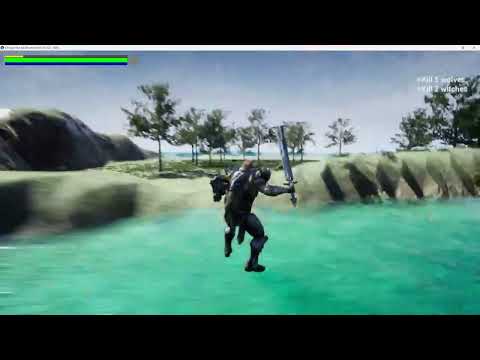

The world of Kalevala is a mythical and magical place inhabited by gods, heroes, witches and other supernatural beings and where the forces of good and evil are constantly at war. The landscape of Kalevala is vast and varied, including forests, lakes, rivers, mountains and the sea. It is a world shaped by the forces of nature, where the spirits of the natural world are seen as powerful and sometimes dangerous beings. The characters in Kalevala are closely connected to the earth and the natural elements and often use their knowledge of the natural world to overcome difficulties and solve problems. The world of Kalevala is also a place of great conflict, where the forces of good and evil are constantly at war. The heroes of "Kalevala" often find themselves in battles with witches, demons and other supernatural beings, using their strength, courage and wisdom to overcome these obstacles. In general, the world of Kalevala is a rich and complex canvas of mythology, nature and culture.
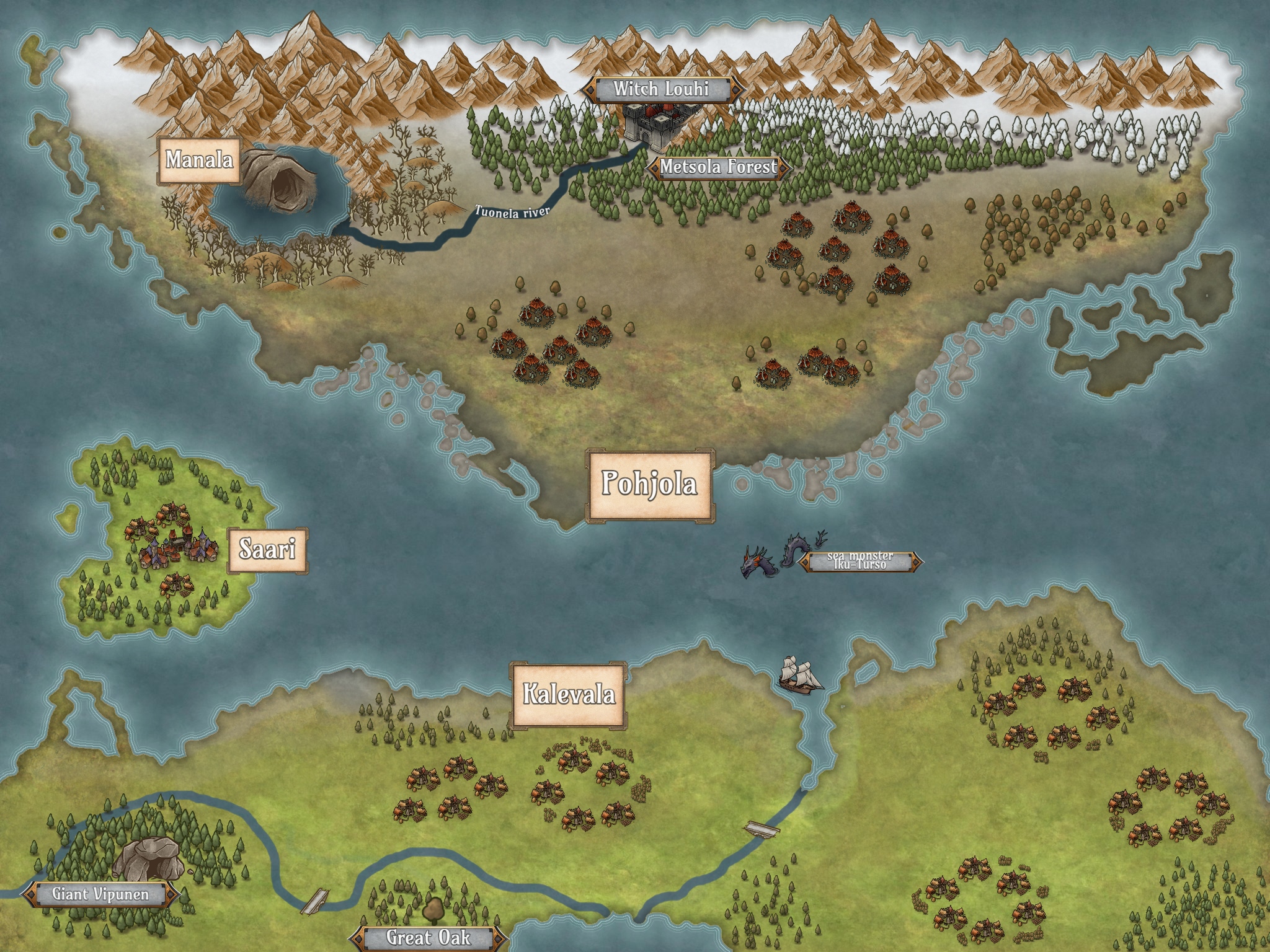 (The map is shown as a rough representation of the game world.)
Kalevala is the land of people, the land of heroes. Kalevala is a fertile and prosperous land rich in forests, lakes and rivers. It is also portrayed as a place of great cultural significance, where traditions of singing and poetry flourish. The people of Kalevala are proud of their heritage and their ability to create powerful songs and spells that they use to solve problems, celebrate important events and honor their ancestors.
Pohjola is the land of cold and darkness in the North, ruled by the witch Louhi. It is a place of hardship where people must fight to survive in harsh conditions. Despite this, Pohjola is also a land of great wealth and magic, and it is from there that the witch Louhi controls most of the northern world.
Manala refers to the underworld or the land of the dead. It is the place where the souls of the dead go after death and is ruled by Tuoni, the god of death.
The main character is an ordinary guy who is given knowledge to the forces of nature and needs to defeat evil. He should grow in experience as the game progresses, and gain new abilities related to nature. The main equipment is a sword or staff, kantele, for casting spells that invoke the power of nature. The clothes are simple, peasant. The ability to put on some small items that somehow affect the abilities of the main character. For example, a leather belt, birch bark sandals, a birch amulet, a bag with Karelian pasties.
The game is planned with chapters, as a parallel with the Kalevala mythology, namely Runes (Songs). Each chapter changes the mood of the game
The game contains quests / stories that are close to ordinary life. And the possibility of performing different emotions for the main character: joy, fear, sadness, indignation. The mood of the music changes from location to location, it will also be possible to change the music in locations depending on the active quest/chapter. Music with folk instruments will be used, there will also be folk songs, sad or funny.
Falls from heights, Grab and Throw like in Control game, the Guiding Wind like in Ghost of Tsushima, Skill trees.
Bosses: Giant - Throws natural objects, causes a strong wind or earthquake (like Earthshatter Reinhardt's Ultimate in Overwatch), which slows down the main character Sorceress - like the concept of Hel-Revenant in God of War: disappearing, teleporting, casting haunting spells Sea Beast - Tries to destroy your ship (like in Resident Evil 4)
Slides with pictures or animated comics (Comic Cinematic like in The Witcher 3) will be shown between chapters.
The ability to complete all additional quests that tell untold moments in the main lore. Perhaps a DLC with "neighborhood" myths.
UMG UI:
- 1. Main Menu
- 2. Quest Menu
- 3. Pause Menu
- 4. Map
- 5. Inventory
- 6. Skill Tree
- 7. Character UI (have only health/stamina/mana progress bars)
Enemy/NPC AI:
- 1. Enemies
- Add more different types
- Add more different movements/behaviors
- 2. NPC
- Add more different types
- Add dialogues/phrases
- Add more different movements/behaviors
- 3. Bosses
- 4. Animals
- Add more different types (Killable / Neutral)
- 5. Factory for Enemy AI
- Factory with PoolSubSystem (because killable actors are binding on objectives in quests at the time of taking, and if quests were taken with this kill-objective, new spawn killable actors doesn't have binding and they won't count. So I need to search/learn more about this situation)
Character:
- 1. Movement
- 2. Attack
- 3. Health
- 4. Quest System
- 5. Inventory
- 6. Skill Tree
- 7. Abilities
Game:
- 1. Quest System
- 2. Save System
- 3. Balance and Enemy Scaling Changes
- 4. Progression mechanics
- 5. Internal economies
Level Design
- 1. Ocean/River/Lake
- 2. Landascape Design
- Add climatic zones, like rain, snow, wind (attaching to character)
- 3. Foliage
- 4. Add unique places (levels), like caves, castle, dungeon
- 5. Add interior in houses, interactable chestes, boxes, etc. (inventory system)
- 6. Open world: load/unload levels maybe by some levels manager (Right now I'm temporarily using only two trigger boxes to load/unload two levels)
Game Design: :sob: I need to learn more about it
I used the UE Content for educational purposes