
A two-player Battleship game running on two independent Arduino Unos, linked by a single 3-wire serial cable.
Each board is a self-contained station — OLED display, analog joystick, two buttons, and a buzzer — and the two boards stay perfectly in sync through a custom framed packet protocol with CRC-8 error detection. No game master, no shared clock: both boards run identical state machines and synchronize only through the packets they exchange.
This was our final project for ECE 3481, built from the chip up: real A/D interfacing, hardware I²C, external interrupts, and an interrupt-driven UART link, all running concurrently on a 16 MHz ATmega328P with 2 KB of RAM.
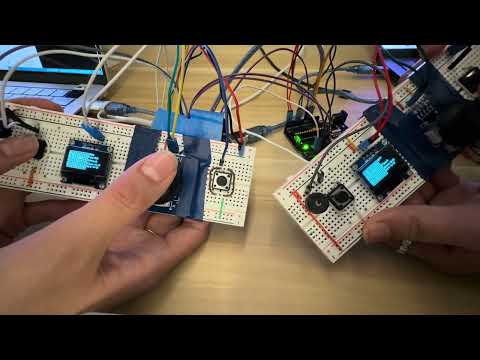
A live two-player match: placing ships by dragging a ghost outline with the joystick, alternating attack turns with a cursor-selected coordinate, and hit/miss feedback over the buzzer — running on two physically separate boards.
- Highlights
- How to Play
- Hardware
- Software Architecture
- The Custom Packet Protocol
- The Game State Machine
- The Concurrency Model
- Analog Input (ADC) & I²C Display
- Build & Flash
- Repository Layout
- Engineering Notes
- Team
- Custom 7-byte framed packet protocol with CRC-8 checksums, a byte-at-a-time receiver state machine, and stop-and-wait reliability (per-command timeouts and retries).
- Two boards, one source of truth, zero shared clock. Synchronization is achieved entirely through idempotent packet exchanges — both boards independently compute the same game state.
- True concurrency on bare metal: an interrupt-driven UART receive buffer accumulates incoming bytes in the background while the foreground loop reads the joystick ADC, drives the I²C display, and runs game logic.
- Real A/D interfacing: a 2-axis analog joystick read through the 10-bit ADC with center calibration, a dead-zone, and rate-limited movement.
- External-interrupt buttons with debounce and press-duration detection (a 3-second hold triggers a coordinated mid-game reset).
- A 12-state finite state machine spanning boot, link handshake, ship placement, networked turns, game-over, and play-again — implemented as a readable
switch, not a framework.
Tech: C++, Arduino (ATmega328P), I²C, UART, ADC, external interrupts, CRC-8, Adafruit SSD1306 / GFX
| Control | In placement | In gameplay |
|---|---|---|
| Joystick | Move the ship "ghost" around the grid | Move the firing cursor |
| Button A (D2) | Place the current ship | Fire at the selected cell |
| Button B (D3) | Rotate the ship (horizontal ↔ vertical) | Toggle between your Fleet view and your Attack view |
| Hold Button B (3 s) | — | Reset both boards back to the title screen |
Each player places three ships (lengths 4, 3, 2 → 9 cells total) on a 10×10 grid, then takes turns firing. First to sink all of the opponent's ships wins. After a game ends, both players vote to play again (A) or quit (B); the first player alternates each round.
Per board (×2 for a full setup):
| Part | Notes |
|---|---|
| Arduino Uno (ATmega328P) | The microcontroller |
| SSD1306 OLED, 128×64 | I²C, address 0x3C |
| 2-axis analog joystick | Two potentiometer axes → ADC |
| 2× tactile push button | Cursor confirm / rotate / view / reset |
| Piezo buzzer | Feedback tones (tone() on a PWM pin) |
| 3× jumper wire | The inter-board link (RX, TX, GND) |
Single board (both boards are wired identically):
| Uno pin | Connects to | Notes |
|---|---|---|
| 5V | OLED VCC, Joystick VCC | Most SSD1306 modules accept 5 V via an onboard regulator — verify your module's silkscreen; if it says "3.3 V only," use the 3.3 V pin. |
| GND | OLED GND, Joystick GND, both buttons (one leg), buzzer (−) | Star-grounded on the rail |
| A4 | OLED SDA | Hardware I²C data — fixed pin, do not reuse |
| A5 | OLED SCL | Hardware I²C clock — fixed pin |
| A0 | Joystick VRx | Analog input |
| A1 | Joystick VRy | Analog input |
| D2 | Button A (other leg → GND) | INPUT_PULLUP, external interrupt INT0 |
| D3 | Button B (other leg → GND) | INPUT_PULLUP, external interrupt INT1 |
| D4 | Inter-board UART RX | SoftwareSerial |
| D5 | Inter-board UART TX | SoftwareSerial |
| D6 | Buzzer (+) | PWM, driven by tone() |
The two boards are joined by a 3-wire UART cable, crossed over:
       Board 0                       Board 1
   ┌────────────┐                ┌────────────┐
   │ D5 (TX) ───┼────────────────┼──→ D4 (RX) │
   │ D4 (RX) ←──┼────────────────┼─── D5 (TX) │
   │ GND     ───┼────────────────┼─── GND     │
   └────────────┘                └────────────┘
TX on one board goes to RX on the other, and the grounds are tied together so both boards share a voltage reference. The link runs at 9600 baud.
The firmware is split into four modules so the hardware, the wire protocol, and the game rules can each be reasoned about (and tested) in isolation.
| Module | Responsibility |
|---|---|
battleship.ino |
The main sketch: pin setup, ISRs, the boot handshake, and the loop() that wires everything together. |
protocol.{h,cpp} |
The packet framer: CRC-8, packet building, the byte-at-a-time receive parser, and the stop-and-wait send/reply logic. Knows nothing about Battleship. |
game.{h,cpp} |
The game state, the FSM transitions, ship placement, hit detection, and turn flipping. Knows nothing about pixels or wires. |
display.{h,cpp} |
All OLED rendering — the grid, ghost outline, firing cursor, status panel, and full-screen state messages. |
The application talks to the protocol layer through a set of onX() callbacks (onFire, onResult, onReady, …) declared in protocol.h and implemented in the sketch. This keeps the design clean: the FSM treats networking like local function calls, and the protocol layer handles framing, acking, and retries underneath it.
We didn't want to trust raw UART bytes, so every byte that crosses the cable is part of a framed packet with a checksum.
┌──────┬─────┬─────┬───────────┬──────┬──────┐
│ 0xAA │ CMD │ LEN │  PAYLOAD  │ CRC8 │ 0x55 │
│ start│ 1B  │ 1B  │   LEN B   │  1B  │ end  │
└──────┴─────┴─────┴───────────┴──────┴──────┘
| Field | Size | Purpose |
|---|---|---|
| START | 1 B (0xAA) |
Sync byte. The 10101010 pattern is distinctive enough that the parser can re-find frame boundaries even after garbage on the line. |
| CMD | 1 B | Command ID (see table below). |
| LEN | 1 B | Payload length, 0–4. |
| PAYLOAD | LEN B |
Command-specific data (coordinates, outcomes, IDs). |
| CRC8 | 1 B | Checksum over [CMD, LEN, PAYLOAD]. Polynomial 0x07 (CRC-8/SMBus), init 0x00. |
| END | 1 B (0x55) |
Belt-and-suspenders sanity byte. |
Fixed overhead is 5 bytes. A FIRE packet (2-byte payload) is 7 bytes total — roughly 7 ms on a 9600-baud link.
| ID | Name | Payload | Reply | When it fires |
|---|---|---|---|---|
0x01 |
HELLO |
board_id (1 B) |
ACK |
Boot handshake |
0x02 |
ACK |
cmd_acked (1 B) |
— | Any blocking send waits for this |
0x03 |
READY |
(none) | ACK |
After ships are placed |
0x04 |
FIRE |
row, col (2 B) |
RESULT |
Player attacks |
0x05 |
RESULT |
row, col, outcome (3 B) |
(none) | Reply to a FIRE |
0x06 |
RESET |
(none) | ACK |
Long-hold B, or quit at game-over |
0x07 |
NACK |
reason (1 B) |
— | Reserved (not used in the MVP) |
0x08 |
BEGIN |
(none) | ACK |
"Press A to start" handshake |
RESULT outcomes: MISS (0x00), HIT (0x01), HIT_SUNK (0x02), HIT_GAMEOVER (0x03).
The exact bytes on the wire:
AA 04 02 04 02 D4 55
↑  ↑  ↑  ↑  ↑  ↑  ↑
│  │  │  │  │  │  └─ END
│  │  │  │  │  └──── CRC-8 over [0x04, 0x02, 0x04, 0x02] = 0xD4  ✓ (verified)
│  │  │  │  └─────── col = 2
│  │  │  └────────── row = 4
│  │  └───────────── LEN = 2
│  └──────────────── CMD = FIRE (0x04)
└─────────────────── START
The receiver computes the same CRC over the same bytes and compares. Match → valid; mismatch → drop the packet and let the sender's retry handle it.
The parser reads one byte at a time and walks these states:
WAIT_START ──(0xAA)──► READ_CMD ──► READ_LEN ──► READ_PAYLOAD ──► READ_CRC ──► READ_END ──► DELIVER
    ▲                                  │              │             │            │
    │                          LEN > 4 │      (LEN bytes)   CRC mismatch    byte ≠ 0x55
    └──────────────────────────────────┴──────────────┴─────────────┴────────────┘
                              frame error → reset, bump error counter
Any frame error (oversized LEN, bad CRC, wrong end byte) just resets the parser to WAIT_START and increments a counter. We don't try to salvage bytes — the sender's retry covers it.
Never more than one packet in flight. When the code calls protocol_send_fire(r, c) it builds the packet, blocks in a tight loop calling protocol_poll(), waits for a matching RESULT, and retries on timeout. Each command type has its own timeout and retry budget:
| Command | Reply | Timeout | Retries |
|---|---|---|---|
HELLO |
ACK |
2 s | 3 |
READY |
ACK |
5 s | 3 |
BEGIN |
ACK |
30 s | 1 (no retry — the partner is reading the instructions) |
FIRE |
RESULT |
3 s | 3 |
RESET |
ACK |
2 s | 2 |
If every retry fails, the send returns false and the board transitions to PHASE_LINK_LOST.
- Auto-ACK in the protocol layer.
HELLO,READY,BEGIN, andRESETare acknowledged inside the protocol module before the application callback even runs. (This fixed a real bug in an earlier version where the app forgot to ACKREADYand the link timed out.) RESULTechoes its(row, col). The sender matches a reply to theFIREit's currently waiting on by coordinate, so a late or duplicateRESULTfor an old shot is simply ignored.- Duplicate
FIREs are idempotent. If aRESULTis lost and the sender retries, the receiver sees the sameFIREagain, detects that the cell already has an outcome, and re-sends the identicalRESULTwithout double-counting the hit.
The whole game is a Phase enum with hand-written switch transitions in game.cpp and battleship.ino — 12 phases spanning bootup, networking, gameplay, and game-end. Both boards run the same machine and stay synchronized through packet exchanges, not wall-clock time.
        ┌──────────┐
        │   BOOT   │  setup()
        └──────────┘
              │
        ┌────────────┐                  ┌──────────────┐
        │ LINK_WAIT  │── link fails ───►│  LINK_LOST   │ (terminal)
        │ HELLO/ACK  │                  └──────────────┘
        └────────────┘
              │ link OK
        ┌────────────┐
        │   TITLE    │  "Press A to start"  (local, no network)
        └────────────┘
              │ press A
        ┌──────────────┐
        │ INSTRUCTIONS │  both players press A  (BEGIN/ACK handshake)
        └──────────────┘
              │ both pressed
        ┌────────────┐
        │   PLACE    │  place 3 ships (4,3,2); A = confirm, B = rotate
        └────────────┘
              │ all placed
        ┌────────────────┐     ACK + partner already READY
        │ SENDING_READY  │──────────────┐
        └────────────────┘              │
              │ ACK, partner not yet     ▼
              ▼                     enterFirstTurn()
        ┌────────────┐                   │
        │  WAIT_OPP  │── partner READY ──┤
        └────────────┘                   │
                                          ▼
        ┌──────────┐   I fire (FIRE→RESULT)   ┌───────────┐
        │ MY_TURN  │ ───────────────────────► │ OPP_TURN  │
        │          │ ◄─────────────────────── │           │
        └──────────┘    partner's FIRE        └───────────┘
              │                                     │
              │ all opponent ships sunk  │ all my ships sunk
              ▼                          ▼
        ┌─────────────────────────────────────┐
        │             GAME_OVER               │  "YOU WON / LOST" (2.5 s linger)
        └─────────────────────────────────────┘
              │
        ┌──────────────┐  both press A → INSTRUCTIONS (gamesPlayed++)
        │  PLAY_AGAIN  │  either presses B → TITLE (RESET sent to partner)
        └──────────────┘
Cross-cutting transitions can fire from any active phase:
- Long-hold B (3 s) →
TITLE(sendsRESET; both boards re-init). - Partner sends
RESET→TITLE. - Any network call fails after retries →
LINK_LOST(terminal).
After both READYs are exchanged, each board independently computes:
firstId = (gamesPlayed % 2 == 0) ? 0 : 1
if (my boardId == firstId)  → MY_TURN
else                        → OPP_TURN
So game 0: board 0 first; game 1: board 1 first; game 2: board 0 again. The boards don't negotiate this — they compute the same answer because each one locally increments gamesPlayed on game-over, keeping the counter deterministic across rounds.
Three things happen "at once" on a single-core MCU, and the design keeps them from stepping on each other:
1. Background — UART receive (interrupt-driven).
SoftwareSerial uses pin-change interrupts to clock incoming bytes into its internal ring buffer while the rest of the program runs. The foreground never blocks on the wire to receive; it just drains whatever has accumulated.
2. Background — button presses (external interrupts).
isrAfires on the falling edge of D2 (INT0): debounced (50 ms), sets avolatile bool aPressed.isrBfires on any change of D3 (INT1): it reads the pin to tell press from release, timestamps the press, and on release classifies it as a short press or a long press (≥ 3 s). This is how the same button does "rotate / toggle view" and "hold to reset."
All shared ISR state is volatile, and the ISRs only set flags — the heavy work happens in the loop.
3. Foreground — the main loop.
loop():
  protocol_poll()        # drain + parse the UART RX buffer, dispatch callbacks
  handle reset request   # partner asked to reset
  play queued buzzer tone # from the last callback's GameEvent
  phase-specific work    # GAME_OVER linger, READY send, begin/play-again votes
  read joystick (ADC)    # rate-limited, dead-zone filtered
  service button flags   # A press, B short, B long
  if dirty: render OLED  # only redraw when something changed
The one place the foreground deliberately blocks is a stop-and-wait send (FIRE, READY, HELLO…). Even then it isn't idle: it spins on protocol_poll(), so incoming packets and auto-ACKs keep flowing while it waits for its reply. A g_dirty flag means the (relatively slow) I²C OLED is only redrawn when state actually changes.
Joystick → ADC. The two joystick axes are read with analogRead() on A0/A1 (the ATmega's 10-bit ADC, 0–1023). Raw readings are turned into discrete grid moves with three pieces of conditioning:
- Center calibration — measured rest points (
≈523,≈514), subtracted so "centered" reads as zero. - Dead-zone — a movement only registers past a threshold of
250, so a resting thumb doesn't drift the cursor. - Rate limiting — at most one move per
180 ms, for deliberate, one-cell-at-a-time navigation instead of a runaway cursor.
The axis-to-direction mapping reflects how the joystick is physically mounted (the Y axis drives left/right and the X axis drives up/down), which is worth knowing if you rebuild the rig in a different orientation.
OLED → I²C. The SSD1306 talks over hardware I²C on A4 (SDA) / A5 (SCL) at address 0x3C. We bump the bus to 400 kHz (Wire.setClock(400000)) — fast mode — because the full-screen redraws (10×10 grid + ghost/cursor + status panel) need the bandwidth to feel responsive. Rendering goes through Adafruit's SSD1306/GFX libraries; the board is stored packed at 4 bits per cell (50 bytes per grid) to stay friendly to the Uno's 2 KB of RAM.
Requirements
- Arduino IDE (or
arduino-cli) - Board: Arduino Uno
- Libraries:
Adafruit GFX Library,Adafruit SSD1306(install via Library Manager).WireandSoftwareSerialship with the IDE.
Steps
- Place all source files (
battleship.ino,protocol.*,game.*,display.*) in a folder namedbattleship/so the IDE recognizes the sketch. - Set the board ID. Near the top of
battleship.ino:Flash one board as#define BOARD_ID 0 // Board 0 — initiates the HELLO handshake // #define BOARD_ID 1 // Board 1 — waits for HELLO
0and the other as1. They are not interchangeable — board 0 initiates the link handshake and board 1 waits for it, and the IDs decide turn order. - Compile and upload to each Uno.
- Power both boards, connect the 3-wire link, and you should see
Linking…resolve to theBattleship :)title screen on both.
Set
#define DEBUG 1to get boot logs and a free-RAM report over the USB serial monitor (9600 baud).
battleship/
├── battleship.ino          # main sketch: setup(), loop(), ISRs, boot handshake
├── protocol.h / .cpp       # packet framer: CRC-8, builder, parser FSM, stop-and-wait
├── game.h / .cpp           # game state, the phase FSM, placement, hit logic
├── display.h / .cpp        # OLED rendering (grid, ghost, cursor, status, screens)
└── docs/
    ├── pinmap.pdf              # single-board pin assignments
    ├── project_proposal.pdf    # original ECE 3481 proposal
    └── protocol_and_fsm.pdf    # protocol + state-machine reference sheet
A few decisions worth calling out:
- Switch-based FSM, not a table. For ~12 states with hand-written transitions, a plain
switchis more readable, easier to step through in a debugger, and has zero abstraction overhead. We didn't reach for a framework when straight-line code does the job in fewer lines. - No separate "waiting for result" phase.
protocol_send_fire()already blocks (≤ 3 s) polling for theRESULT, soMY_TURNtransitions straight toOPP_TURN— the display flashes "firing" too briefly to matter. - Stale-input guard. When both players press A to leave the instructions screen, a finger still on the button could let a queued press leak into
PLACEand auto-place a ship.clearInputFlags()is called on every transition into an input-taking state to prevent that. - Synchronization without a shared clock. The core trick: never assume the two boards are in step. Every state transition is made idempotent, and the packet exchanges themselves act as the synchronization points.
- Tested the framer in isolation — the parser was unit-tested on one board (including corrupted CRCs and back-to-back packets) before either board ever drove the wire.
Eva & Maggie's ECE 3481 Final Project
Built because the best games are the ones that put two people in the same room.