I was following this tutorial: Reconstructing density matrix, step by step but for a different system and I got the following error:
EDIT:: I got the same error when running the code of the tutorial using the same data as the one used in the tutorial.
    TypeError                                 Traceback (most recent call last)
<ipython-input-1-8ff604d7d30e> in <module>
     74 ]
     75
---> 76 nn_state.fit(
 77     data=train_samples,
 78     input_bases=train_bases,


~/.virtualenvs/qucumber/lib/python3.10/site-packages/qucumber-1.3.2-py3.10.egg/qucumber    /nn_states/density_matrix.py in fit(self, data, epochs, pos_batch_size, neg_batch_size, k,         lr, input_bases, progbar, starting_epoch, time, callbacks, optimizer, optimizer_args, scheduler, scheduler_args, **kwargs)
    352             raise ValueError("input_bases must be provided to train a DensityMatrix!")
    353         else:
--> 354             super().fit(
    355                 data=data,
    356                 epochs=epochs,

~/.virtualenvs/qucumber/lib/python3.10/site-packages/qucumber-1.3.2-py3.10.egg/qucumber/nn_states/neural_state.py in fit(self, data, epochs, pos_batch_size, neg_batch_size, k, lr, input_bases, progbar, starting_epoch, time, callbacks, optimizer, optimizer_args, scheduler, scheduler_args, **kwargs)
630                 scheduler.step()
631
--> 632             callbacks.on_epoch_end(self, ep)
   633             if self.stop_training:  # check for stop_training signal
634                 break

~/.virtualenvs/qucumber/lib/python3.10/site-packages/qucumber-1.3.2-py3.10.egg/qucumber/callbacks/callback_list.py in on_epoch_end(self, rbm, epoch)
 69     def on_epoch_end(self, rbm, epoch):
 70         for cb in self.callbacks:
---> 71             cb.on_epoch_end(rbm, epoch)
 72
 73     def on_batch_start(self, rbm, epoch, batch):

~/.virtualenvs/qucumber/lib/python3.10/site-packages/qucumber-1.3.2-py3.10.egg/qucumber/callbacks/metric_evaluator.py in on_epoch_end(self, nn_state, epoch)
131             metric_vals_for_epoch = {}
132             for metric_name, metric_fn in self.metrics.items():
--> 133                 val = metric_fn(nn_state, **self.metric_kwargs)
134                 metric_vals_for_epoch[metric_name] = val
135

~/.virtualenvs/qucumber/lib/python3.10/site-packages/qucumber-1.3.2-py3.10.egg/qucumber/utils/__init__.py in wrapped_f(*args, **kwargs)
 70         def wrapped_f(*args, **kwargs):
 71             kwargs = self.rename(f.__name__, kwargs)
---> 72             return f(*args, **kwargs)
 73
 74         return wrapped_f

~/.virtualenvs/qucumber/lib/python3.10/site-packages/qucumber-1.3.2-py3.10.egg/qucumber/utils/training_statistics.py in fidelity(nn_state, target, space, **kwargs)
 70         # Instead of sqrt'ing then taking the trace, we compute the eigenvals,
 71         #  sqrt those, and then sum them up. This is a bit more efficient.
---> 72         eigvals = np.linalg.eigvals(prod).real  # imaginary parts should be zero
 73         eigvals = np.abs(eigvals)
 74         trace = np.sum(np.sqrt(eigvals))

~/.virtualenvs/qucumber/lib/python3.10/site-packages/numpy/core/overrides.py in eigvals(*args, **kwargs)

~/.virtualenvs/qucumber/lib/python3.10/site-packages/numpy/linalg/linalg.py in eigvals(a)
   1042     _assert_stacked_square(a)
   1043     _assert_finite(a)
-> 1044     t, result_t = _commonType(a)
   1045
   1046     extobj = get_linalg_error_extobj(

~/.virtualenvs/qucumber/lib/python3.10/site-packages/numpy/linalg/linalg.py in _commonType(*arrays)
145             if rt is None:
146                 # unsupported inexact scalar
--> 147                 raise TypeError("array type %s is unsupported in linalg" %
148                         (a.dtype.name,))
149         else:

TypeError: array type complex256 is unsupported in linalg
I don't believe the problem is with the Physics but with the matrix I am using, but I tried a torch.reshape(my_matrix, (-1,)) and I got the same error.
Details, if needed, are given below:
Samples of the matrices are:
GHZ_state_real.txt:

GHZ_state_imag.txt:
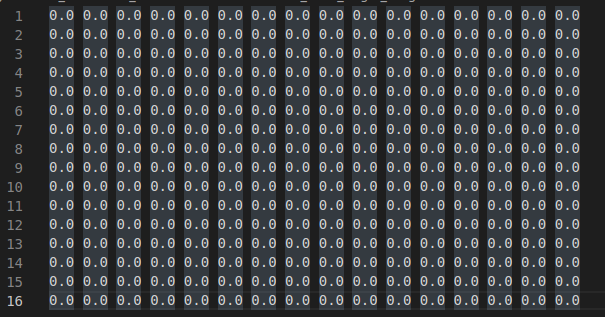
The first one is the real part of the system, and the second matrix is the imaginary part (just a bunch of zeros). Both are 16x16.
I loaded the data with:
import torch
from qucumber.nn_states import DensityMatrix
from qucumber.callbacks import MetricEvaluator
import qucumber.utils.unitaries as unitaries
import qucumber.utils.training_statistics as ts
import qucumber.utils.data as data
import qucumber

train_samples, true_matrix, train_bases, bases = data.load_data_DM(
train_path, matrix_path_real, matrix_path_imag, train_bases_path, bases_path
)

unitary_dict = unitaries.create_dict() #A dictionary with unitary matrix

nv = train_samples.shape[-1] # Number of visible layers for the RBM
nh = na = nv # Number of hidden and auxiliary layers

nn_state = DensityMatrix(
num_visible=nv, num_hidden=nh, num_aux=na, unitary_dict=unitary_dict, gpu=False
)

epochs = 500
pbs = 100  # pos_batch_size
nbs = pbs  # neg_batch_size
lr = 10
k = 10
lr_drop_epoch = 125
lr_drop_factor = 0.5

def partition(nn_state, space, **kwargs):
    return nn_state.rbm_am.partition(space)

period = 25
space = nn_state.generate_hilbert_space()

callbacks = [
    MetricEvaluator(
        period,
        {
            "Fidelity": ts.fidelity,
            "KL": ts.KL,
            "Partition Function": partition,
        },
        target=true_matrix,
        bases=bases,
        verbose=True,
        space=space,
    )
]

nn_state.fit(
    data=train_samples,
    input_bases=train_bases,
    epochs=epochs,
    pos_batch_size=pbs,
    neg_batch_size=nbs,
    lr=lr,
    k=k,
    bases=bases,
    callbacks=callbacks,
    time=True,
    optimizer=torch.optim.Adadelta,
    scheduler=torch.optim.lr_scheduler.StepLR,
    scheduler_args={"step_size": lr_drop_epoch, "gamma": lr_drop_factor},
)
If you look at the link at the top you'll see that this is the same code that they used in the tutorial, but there the system is for a 2 qubit state, and here I am trying to reproduce for a 4 qubit state, thus my matrix is bigger.
The other data are:
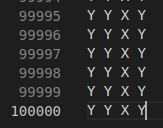
A 10k lines .txt file with 4 columns indicating the measurement bases for the system.

Which is just another 10k lines .txt file with measurement results.
And
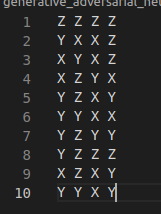
which is just a 10 line .txt indicating the unique measurement bases.
I don't know how to solve this problem and continue working. Is it a reshape problem or do I need to convert the complex256 to a complex128? According to this link numpy supported data types there is no complex256 data type supported in numpy, but my matrix are 16x16 and there is nothing I can do about it.
I a learning qucumber so I don't know if the piece of code which is producing this large dtype (complex256) is torch, numpy or qucumber. Probably it is because of the 16x16 matrix but how can I handle this?
Any help?

I was following this tutorial: Reconstructing density matrix, step by step but for a different system and I got the following error:
EDIT:: I got the same error when running the code of the tutorial using the same data as the one used in the tutorial.
I don't believe the problem is with the Physics but with the matrix I am using, but I tried a
torch.reshape(my_matrix, (-1,))and I got the same error.Details, if needed, are given below:
Samples of the matrices are:
GHZ_state_real.txt:GHZ_state_imag.txt:The first one is the real part of the system, and the second matrix is the imaginary part (just a bunch of zeros). Both are 16x16.
I loaded the data with:
If you look at the link at the top you'll see that this is the same code that they used in the tutorial, but there the system is for a 2 qubit state, and here I am trying to reproduce for a 4 qubit state, thus my matrix is bigger.
The other data are:
A 10k lines .txt file with 4 columns indicating the measurement bases for the system.
Which is just another 10k lines .txt file with measurement results.
And
which is just a 10 line .txt indicating the unique measurement bases.
I don't know how to solve this problem and continue working. Is it a reshape problem or do I need to convert the
complex256to acomplex128? According to this link numpy supported data types there is nocomplex256data type supported in numpy, but my matrix are 16x16 and there is nothing I can do about it.I a learning qucumber so I don't know if the piece of code which is producing this large dtype (complex256) is
torch,numpyorqucumber. Probably it is because of the 16x16 matrix but how can I handle this?Any help?